

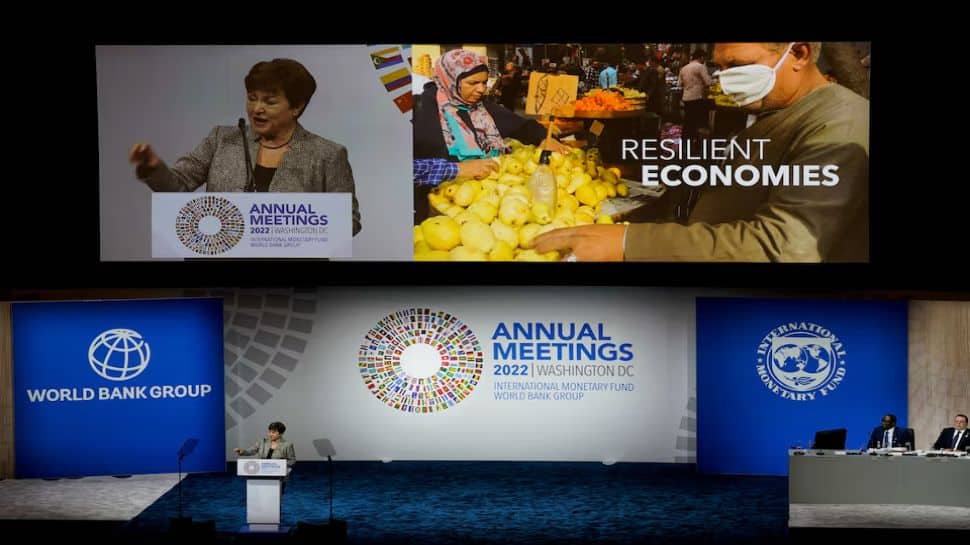
In 2025, Argentina, Ukraine, and Egypt stand out as the International Monetary Fund’s (IMF) largest borrowers, collectively accounting for nearly half of the $162 billion currently owed. This financial landscape was a key topic at recent IMF and World Bank gatherings in Washington, D.C., where global financial delegates convened. The central focus of these discussions is the profound impact of these debts on worldwide economic stability, the intricacies of debt management, and the development of supportive strategies for nations grappling with severe financial crises. The IMF has additionally flagged concerns about financial distress, partly fueled by U.S. trade policies and escalating protectionist sentiments.
The IMF serves as a critical ‘lender of last resort,’ providing essential financial lifelines to countries experiencing acute economic emergencies when traditional lending sources are inaccessible. However, these crucial loans are typically disbursed under strict conditions, often necessitating austerity measures that can impose significant social and economic hardships on populations, making IMF assistance a complex and often challenging proposition.
Established in 1944, the IMF’s mandate is to ensure global economic stability. It has expanded significantly from its initial 44 member states to 191 today, working in tandem with the United Nations. The organization’s support encompasses policy guidance, emergency financial aid, and institutional strengthening. Membership is open to all nations, subject to approval by current members. Funding for the IMF comes from member countries, with contributions scaled according to economic size. These contributions determine a nation’s quota, influencing its borrowing capacity and voting influence. The IMF possesses a lending capacity of approximately $1 trillion, with creditor nations earning interest on their pooled funds.
As of mid-October, the IMF’s total outstanding credit reached an unprecedented SDR 118.9 billion, approximately $162 billion, spread across 86 countries. Argentina is the foremost debtor, owing SDR 41.8 billion (about $57 billion). Ukraine follows with SDR 10.4 billion ($14 billion), and Egypt with SDR 6.9 billion ($9 billion). These three nations collectively represent almost 50% of the total IMF debt.
Argentina’s leading position as the IMF’s largest borrower is due to its consistent need for external financial assistance, receiving its 23rd program, a $20 billion bailout, to stabilize its economy. Its history with the IMF includes the largest single loan ever granted in 2018 ($57 billion) to address fiscal instability and inflation. In October 2025, a substantial financial support package, including a $20 billion currency swap, was announced by the U.S. to reinforce Argentina’s foreign currency reserves.
Ukraine’s debt of over $14 billion is a stark indicator of the economic damage inflicted by the 2022 Russian invasion. Its external debt load has more than doubled, standing at $152 billion by April. The IMF approved a $15.5 billion Extended Fund Facility (EFF) in March 2023, part of an international effort to stabilize Ukraine’s war-torn economy and support essential civilian expenditures and debt obligations.
Egypt’s significant debt burden stems from its recurrent need to borrow to maintain economic equilibrium amid high deficits, low foreign exchange reserves, and persistent inflation. A substantial $11.9 billion EFF program in 2016 aimed to tackle long-standing economic issues. More recently, in March 2025, the IMF provided $1.2 billion following the fourth review of an $8 billion reform initiative, with signs of economic moderation reported.
While the dollar amounts of IMF loans are substantial, their proportion relative to a country’s overall debt and GDP can vary. However, for certain nations, this ratio is significant. Suriname leads this metric at 13% of GDP, followed by the Central African Republic (9.4%), Argentina (8.3%), Barbados (7.4%), and The Gambia (6.95%).