

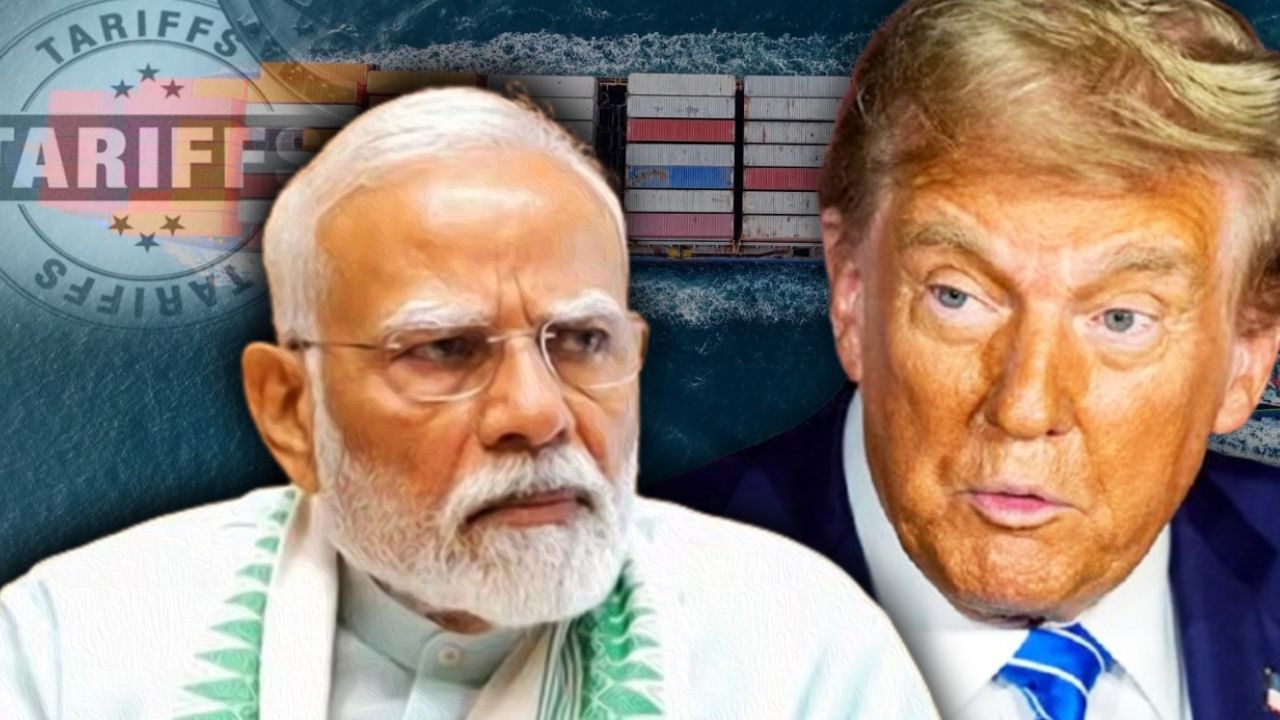
Trump, who had promised to end the Russia-Ukraine war within a day of winning the presidential election, is now facing criticism as the conflict persists. The US is now directing blame towards India, accusing it of benefiting from Russian oil purchases and consequently imposing a 50% tariff on Indian goods starting August 27th.
The war, which began in February 2022, has resulted in over 400,000 casualties. Russia has suffered around 250,000 deaths, including military personnel, while Ukraine’s death toll exceeds 100,000. This raises the question: Why is Trump deflecting responsibility for his failures by targeting India?
1. Efforts to Influence the European Union
Europe’s unwavering support for Ukraine has prompted the US to seek similar action from European nations regarding India. However, the European Union (EU) has remained silent on the matter. Trump’s advisors have initiated a strategy of holding India responsible for the conflict.
Trump’s meeting with Russian President Vladimir Putin in Alaska on August 15th yielded no results, followed by discussions with Ukrainian President Volodymyr Zelensky and European leaders at the White House on August 18th, which also failed to produce any outcomes.
Trump’s trade advisor, Peter Navarro, stated on August 29th that tariffs on India were imposed to curb financial support for Putin’s war efforts. Navarro previously referred to the Russia-Ukraine conflict as ‘Modi’s war,’ alleging that India was exacerbating the situation through its Russian oil imports.
2. Allegations Against Biden for Initiating the War
Trump has persistently blamed Biden for instigating the war, asserting that the conflict would not have erupted under his presidency. While Trump continues to advocate for a peaceful resolution, a swift peace agreement between Russia and Ukraine remains uncertain. Trump’s special envoy, Steve Witkoff, expressed doubts about a resolution this year.
Prior to the failure of a potential agreement, Trump’s team focused on India. Trump’s threats have had little impact on Russia and Ukraine. On August 22nd, Trump set a two-week deadline for peace talks, stating that failure to achieve results would necessitate an alternative approach.
This isn’t the first time Trump has set a two-week timeframe for addressing the Ukraine issue; he has employed similar timelines previously. In May, he stated that any lack of seriousness from Putin regarding a peace agreement would warrant a different response.
3. Attempt to Exert Pressure on Russia Through India
As the US struggles to directly pressure Russia, it’s trying to involve India to achieve that. The tariffs imposed by Trump haven’t been successful. However, this tactic appears to be backfiring. India is actively engaging with 40 countries to counter the tariffs, seeking to expand the global market reach for Indian goods.
American economist Richard Wolf observed that Trump’s imposition of tariffs on India is a display of his ‘tough guy’ persona, but in reality, it’s counterproductive. Trump’s approach is seen as pushing BRICS as a potential economic alternative to the West.
Navarro, Trump’s advisor, claimed that prior to the Ukraine war, India’s Russian oil imports were below 1%, but have now surged to over 30%, or 1.5 million barrels per day. He attributes this increase to profits, rather than domestic demand. India, however, maintains that its Russian oil purchases have stabilized global oil prices.