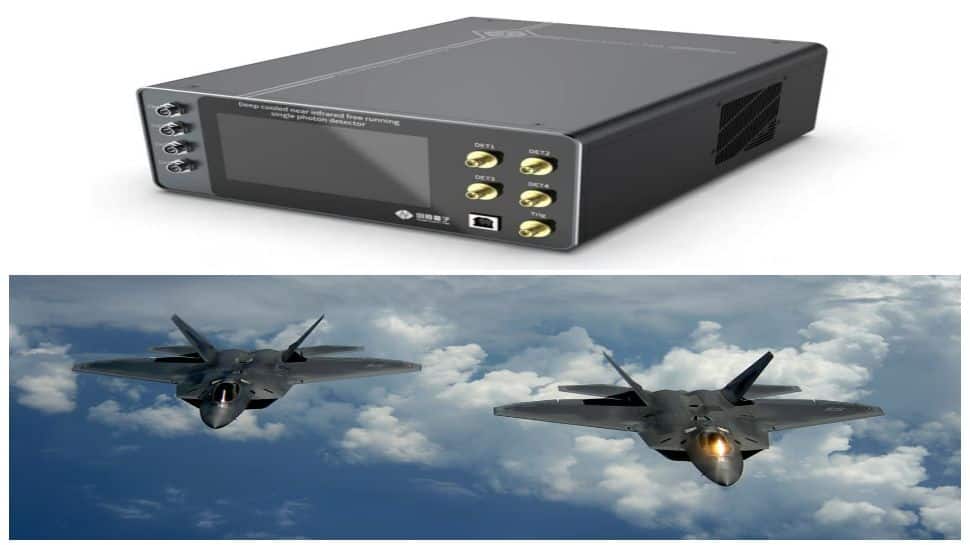
A new era in aerial surveillance has dawned with China’s unveiling of the ‘Photon Catcher,’ the world’s first ultra-sensitive quantum radar detector ready for mass production. This innovative device is designed to detect the faintest signals, specifically individual photons, making it exceptionally adept at spotting stealth aircraft that have long eluded traditional radar. The technology, a product of the Quantum Information Engineering Technology Research Center, is poised to enhance China’s capabilities in quantum radar and communication, posing a challenge to sophisticated fighter jets like the American F-22 Raptor and India’s Rafale. Reports highlight the Photon Catcher’s ability to isolate a single photon from billions, a level of sensitivity that promises to revolutionize detection capabilities. This principle is fundamental to the operation of quantum radar, allowing for the identification of extremely faint energy signatures. Stealth aircraft, which employ specialized designs and materials to minimize radar cross-sections, may find their invisibility compromised. Quantum radar operates by analyzing the subtle quantum state changes in photons reflected off targets. According to quantum mechanics, these changes cannot be perfectly mimicked by stealth technologies, allowing the radar to identify and track aircraft even when they attempt to evade detection. Furthermore, the system’s low power usage and stealthy emissions make it difficult to counter, ensuring its effectiveness across various operational scenarios. The implications for air forces operating advanced platforms, including India’s Rafale, are substantial, potentially altering the balance of power in contested airspace.