

A renewed sense of urgency pervades Pakistan’s defense circles, stirred by the lingering specter of past satellite failures. The humiliation of ‘Operation Sindoor,’ where vital command and control systems went dark, has reportedly caused significant consternation among top leadership, including Army Chief Asim Muneer and Prime Minister Shahbaz Sharif. This vulnerability has sparked fears of a repeat performance and accelerated Pakistan’s strategic alignment with China and Turkey in space technology development.
The events of May 2025 served as a stark wake-up call. In response to a major terror attack, Pakistan’s primary military satellite, the PRSS-1, failed to provide continuous surveillance. The satellite transmitted a single image during a critical offensive operation before becoming inoperable, reportedly due to adverse weather conditions and orbital misalignments. This inability to track enemy movements in real-time left Pakistan’s forces at a distinct disadvantage.
The operational failure of the PRSS-1, coupled with the prior malfunction of the PakTES-1A satellite, created a critical gap in Pakistan’s intelligence gathering capabilities. This two-pronged crisis necessitated an immediate and comprehensive re-evaluation and rebuilding of the nation’s entire space-based surveillance infrastructure.
Facing this critical need, Pakistan has actively sought out international partners to bolster its space program. China has become a cornerstone of this strategy, with Turkey also emerging as a key collaborator. Engagement with European companies and discreet overtures to American entities have also been part of this expanded network.
In a rapid series of developments, Pakistan has successfully launched several new satellites. Among them is PAUSAT-1, a 10U nano-class satellite, a joint project between Air University in Pakistan and Istanbul Technical University. This satellite, launched via SpaceX’s Falcon-9, is equipped with advanced high-resolution cameras and sensors for detailed terrestrial observation. The involvement of Turkish institutions potentially offers Pakistan a gateway to sophisticated European space technologies.
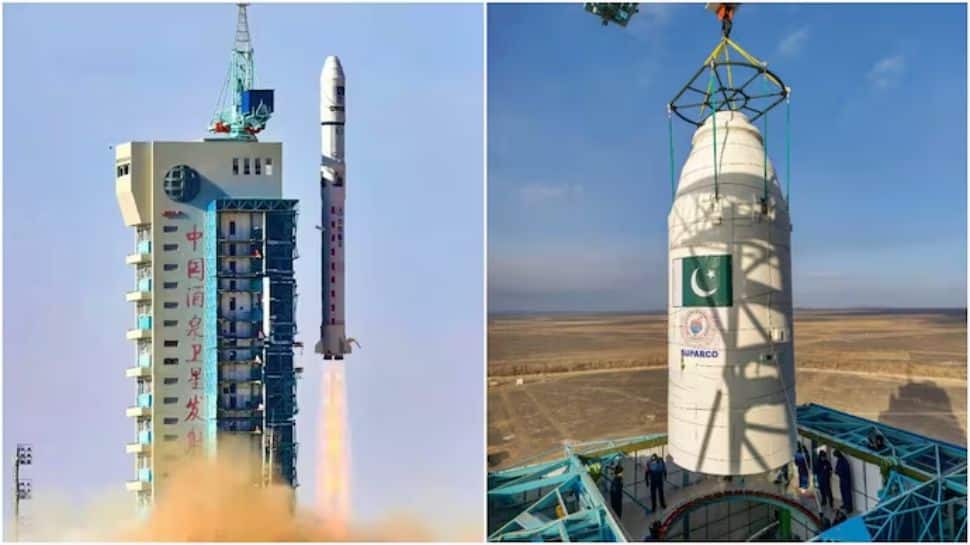
Further enhancing its orbital assets, Pakistan launched PRSC-EOL from China’s Jiuquan space center on January 17. Although officially branded as a Pakistani-made satellite, its development, technological foundation, and launch were entirely managed by China. PRSC-EOL is designed for environmental monitoring and analysis, with clear implications for military intelligence.
Additionally, HS-1 was placed in orbit in October 2024, with China handling its deployment. This satellite features hyperspectral sensors capable of identifying hidden military facilities, monitoring activities around airbases, and detecting concealed structural modifications, making it an invaluable intelligence-gathering tool.
The limitations of the previous PRSS-1 system, which struggled with weather and orbital issues leading to significant intelligence gaps, are being actively addressed. Pakistan’s ground infrastructure, with only two stations and one severely impacted by recent flooding, presents another challenge. The reliance on external providers like Airbus for imagery, with delays of up to 48 hours, is insufficient for time-sensitive military operations, highlighting the strategic advantage offered by China’s faster delivery times.
Pakistan’s next strategic objective is the acquisition of its own Synthetic Aperture Radar (SAR) satellites, anticipated for the 2026-27 timeframe. SAR technology promises all-weather, day-and-night imaging capabilities, revolutionizing Pakistan’s defense readiness by providing real-time, unhindered situational awareness.