

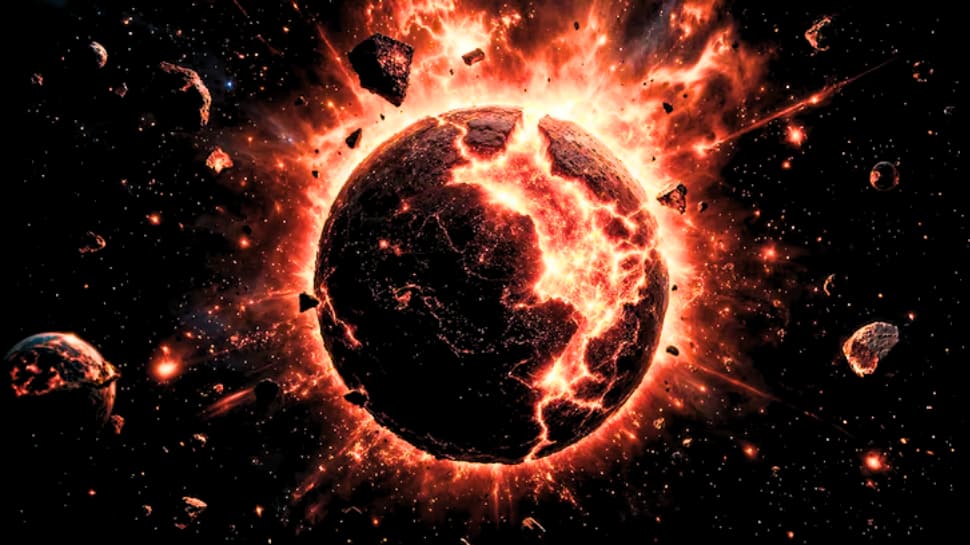
The long-accepted narrative of an ever-expanding, increasingly cold universe is being challenged by groundbreaking new research. Instead of a gradual fading, scientists now propose that our cosmos might be on a collision course with a dramatic end. A theoretical framework developed by a team led by Cornell University physicist S.-H. Henry Tye suggests that the universe’s expansion will cease and reverse, leading to a catastrophic ‘Big Crunch’ within billions of years.
This paradigm-shifting model hinges on the perplexing nature of dark energy. Traditionally viewed as a constant force driving galaxies apart, new data from major surveys like the Dark Energy Survey (DES) and the Dark Energy Spectroscopic Instrument (DESI) indicates this force might be dynamic and could even be negative. If dark energy’s cosmological constant (Λ) is indeed negative, it would imply a reversal of its effect, allowing gravity to initiate a cosmic contraction.
The proposed timeline is stark: expansion will stop in approximately 10 billion years. Following this, the universe will begin to contract, with the process accelerating over the next 9 billion years. The ultimate endpoint, according to this model, is a Big Crunch around 20 billion years from now. This scenario sees all matter and energy, including spacetime itself, compressed into an ultimate singularity.
A key element in this theory involves ultralight axions, hypothetical particles that could be responsible for both dark matter and dark energy. The model posits that these axions change over eons, gradually altering the behavior of dark energy. This subtle shift could flip the cosmic script from expansion to contraction. This stands in stark contrast to the widely anticipated ‘Big Freeze’ scenario.
While the existence of axions and the precise nature of dark energy remain subjects of intense investigation, the mathematical elegance of this collapse model, coupled with its surprising alignment with current DES and DESI data, lends it significant credibility. Further observations from upcoming astronomical projects are crucial. These advanced instruments will provide more detailed insights into dark energy, potentially validating or refuting the idea of an impending cosmic collapse. The possibility that the universe has a finite lifespan, ending in a violent crunch rather than a peaceful fade, has dramatically reshaped the conversation about our cosmic destiny.