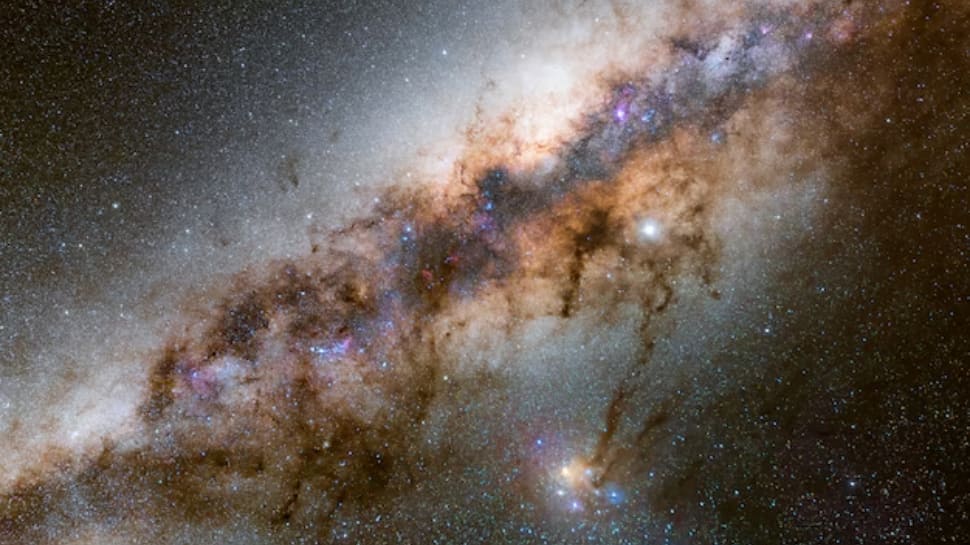
The universe’s most enigmatic component, dark matter, may finally be revealing itself through an unusual gamma-ray emission at the Milky Way’s center. This invisible scaffolding that holds galaxies together has long been a subject of intense scientific inquiry. Now, analysis of data from NASA’s Fermi Gamma-ray Space Telescope has uncovered a diffuse glow originating from our galaxy’s core, a light source that cannot be attributed to conventional astrophysics. Experts from Johns Hopkins University and the Leibniz Institute for Astrophysics are investigating two plausible origins for this eerie luminescence: the energetic processes within dying stars or the direct byproduct of dark matter particle interactions. The latter scenario offers the first tangible evidence for dark matter, a substance that, despite its overwhelming prevalence, remains undetectable through conventional means. Its existence is inferred solely by its gravitational effects on visible matter. Researchers have painstakingly modeled the distribution of dark matter within our galaxy and found a striking similarity between these simulations and the observed gamma-ray emissions. This alignment supports the theory that as the Milky Way evolved, dark matter particles may have congregated in the core, leading to collisions that produce the observed radiation. While some scientists propose that highly magnetized pulsars could be responsible, the scientific community eagerly awaits further data from advanced instruments like the Cherenkov Telescope Array, which promises to resolve this cosmic puzzle and potentially confirm dark matter’s elusive presence.