

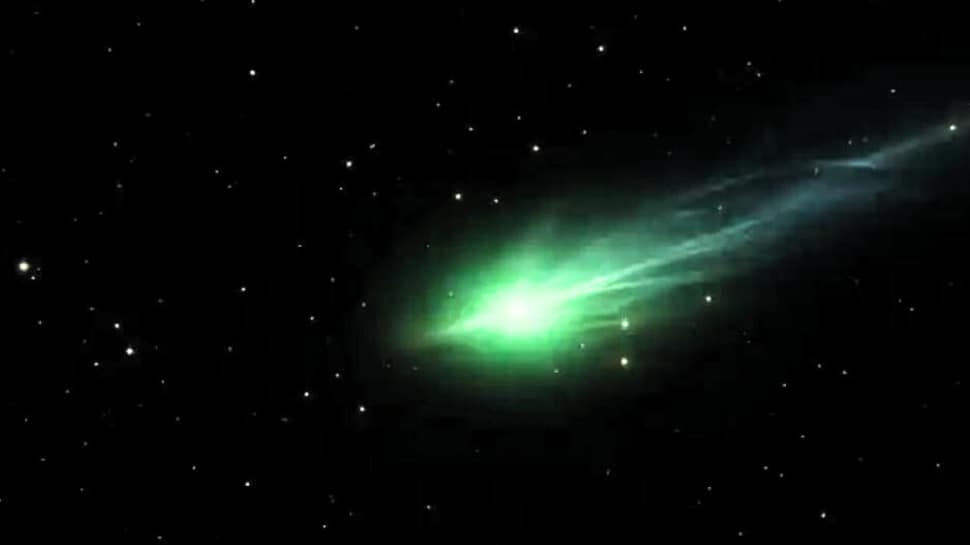
The interstellar visitor 3I/ATLAS, first observed in July 2025, has shattered all expectations, proving far more resilient than predicted. Astronomers anticipated a typical comet encounter: a brief spectacle followed by disintegration under the Sun’s glare. Instead, 3I/ATLAS, with its distinctive blue-green luminescence and a tail stretching over a million kilometers, has become a captivating enigma. Its latest display of resilience occurred in November, navigating a perilous journey behind the Sun – an event that should have led to its demise.
Remarkably, the comet re-emerged from its solar pass seemingly unscathed. This unprecedented survival has reignited scientific discussion and captured public imagination, particularly concerning potential artificial origins. Avi Loeb, a Harvard astrophysicist known for exploring theories of extraterrestrial technology, has amplified these speculations.
New imagery acquired by the Nordic Optical Telescope on November 11 reveals 3I/ATLAS as a singular, active body, showing no signs of fragmentation. Loeb interprets this observation with concern, citing the extraordinary power of the comet’s mass-loss jets. He argues that a natural comet nucleus of its estimated size would require an absorptive surface area larger than Manhattan to generate such energetic outflows, a scenario he finds scientifically improbable based on existing data.
Loeb’s detailed calculations indicate a significant energy imbalance. He posits that the solar energy received at perihelion is insufficient to power the observed jets without an exceptionally large absorptive area, estimated at over 1,600 square kilometers. This discrepancy, he suggests, points towards a non-natural explanation. The presence of an anti-tail, a rare phenomenon where material points towards the Sun, further fuels his hypothesis.
Loeb provocatively suggests that these powerful jets might not be natural gas and ice expulsions, but rather ‘technological thrusters.’ He speculates this could be a deliberate propulsion system designed to increase the object’s velocity after its close solar flyby, a maneuver that could also explain its intact survival.
However, the scientific community remains divided. Darryl Seligman, an astronomy professor, counters that the comet’s survival is entirely consistent with its estimated 1 km nucleus size, which is considered substantial for a comet. He believes Loeb’s assumptions regarding mass-loss rates are potentially exaggerated, and that 3I/ATLAS is exhibiting standard cometary behavior.
Adding weight to the natural comet argument, South Africa’s MeerKAT radio telescope detected hydroxyl radicals on October 24. These molecules, formed when sunlight breaks down water, are a classic signature of a comet releasing vapor. The presence of this signal, which was absent in September, strongly indicates that 3I/ATLAS is a water-rich comet undergoing normal outgassing near the Sun.
Ultimately, 3I/ATLAS remains a profound cosmic mystery, debated as either a resilient natural phenomenon or a potential sign of advanced extraterrestrial engineering. Regardless of its true nature, this interstellar visitor has undoubtedly challenged our understanding of the universe.