

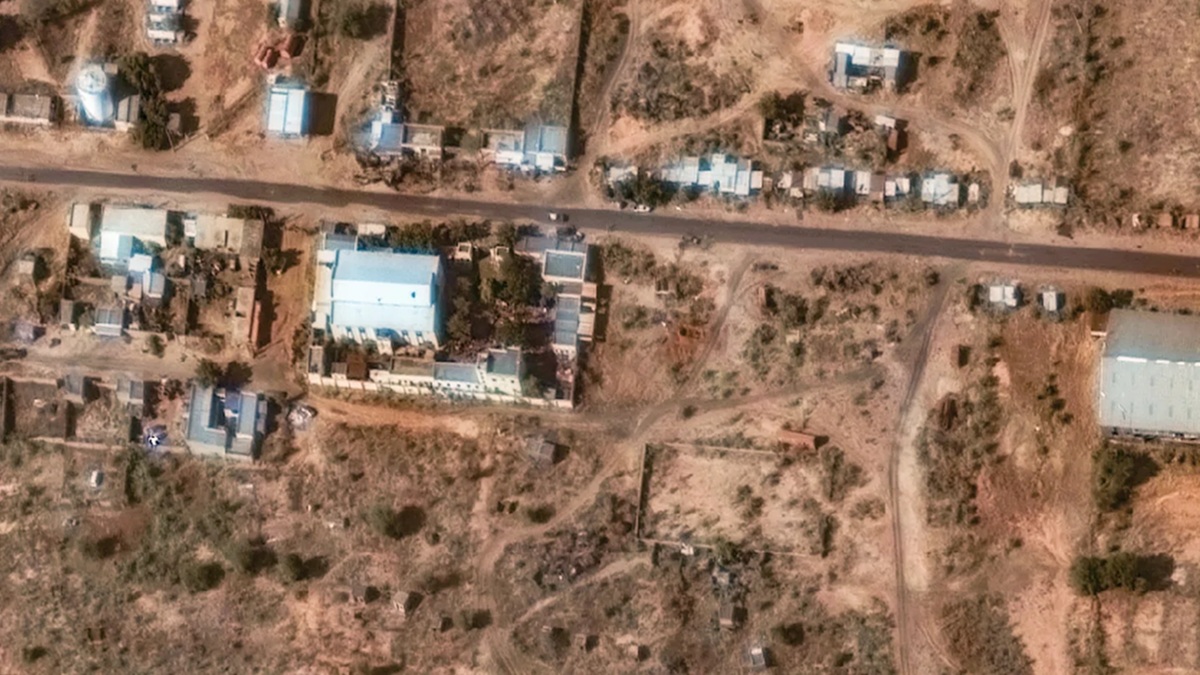
Grim evidence has emerged from satellite imagery indicating mass burial sites in el-Fasher, Sudan, following the capture of the city by the Rapid Support Forces (RSF). Researchers from Yale School of Public Health’s Humanitarian Research Lab, utilizing Vantor satellite imagery, have identified two primary areas of concern for mass graves. One site is situated near a mosque north of the Saudi hospital, and the other is located adjacent to a former children’s hospital, reportedly now used as an RSF prison. The researchers have noted that the true death toll is likely underestimated due to the practice of interring multiple bodies in single graves. The Associated Press independently verified the satellite visuals, confirming recently disturbed earth at both locations, which serves as a strong indicator of extensive burial activities.
Earlier satellite images captured shortly after the RSF’s advance showed dispersed white objects near the Saudi and children’s hospitals, believed to be corpses, alongside apparent bloodstains. Eyewitness testimonies, video evidence circulating online, and field reports collectively describe significant killings occurring after the city fell to the RSF. While the RSF has issued denials regarding their responsibility for the deaths at the hospital, their own distributed video footage from the vicinity, though it features recognizable landmarks, intentionally avoids showcasing fighters with deceased individuals or executing survivors.
Further analysis of Planet Labs imagery from late October documented similar white shapes near a northern embankment outside el-Fasher, accompanied by evidence of burned vehicles. The Yale lab’s assessment points to the subsequent removal of many of these bodies, suggesting a deliberate effort to obscure evidence of atrocities. The lack of reliable communication networks and the prevailing instability in el-Fasher severely hinder efforts to accurately count the victims. Among the casualties is Dr. Adam Ibrahim Ismail, a local doctor reportedly detained and killed by RSF forces, an act the Sudan Doctors’ Network has decried as a direct assault on medical professionals. UN Secretary-General António Guterres has publicly demanded accountability for what he termed ‘horrendous’ atrocities. The ongoing burials within RSF-controlled territories may present insurmountable challenges for any future investigations into potential war crimes.
The escalating violence extends beyond el-Fasher, as evidenced by a recent drone strike in el-Obeid, North Kordofan, that resulted in at least 40 fatalities. Local sources have implicated the RSF in this attack, highlighting their increasing reliance on drone technology. The UN’s humanitarian coordination office has confirmed widespread casualties but has not attributed blame. The conflict, which erupted in April 2023 between the RSF and the Sudanese Armed Forces, has turned Kordofan and Darfur into major battlegrounds. Estimates from the UN place the death toll at over 40,000, though independent organizations believe the actual number is significantly higher. The war’s impact is a deepening humanitarian crisis, with over 14 million Sudanese displaced and famine and disease spreading rapidly, pushing two regions to the brink of starvation.