

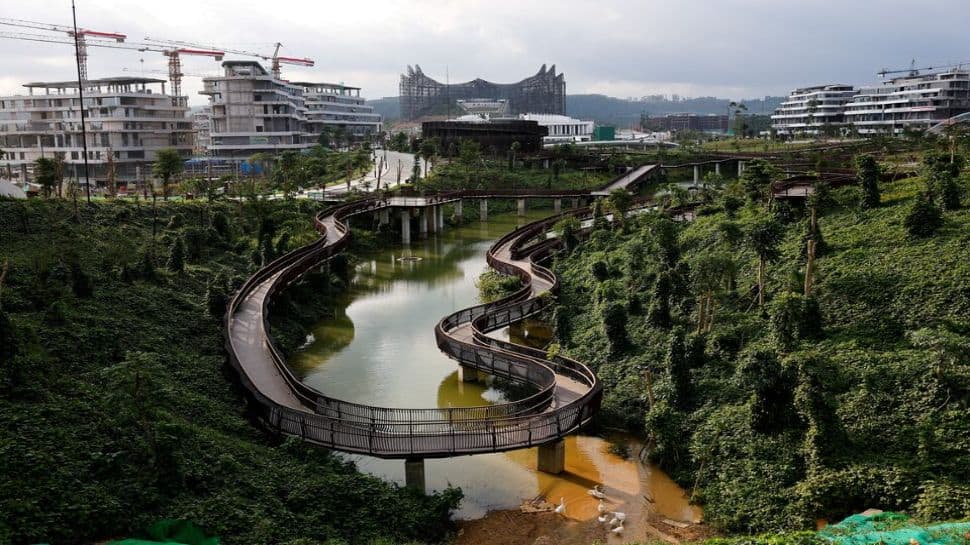
Indonesia’s ambitious endeavor to build a new capital city in Borneo, intended to replace the overcrowded Jakarta, is now confronting serious doubts about its viability. Nusantara, the planned futuristic metropolis, risks becoming an empty shell, a stark departure from its intended role as a beacon of progress for the world’s largest Muslim nation. The initial concept, championed by former President Joko Widodo, aimed for a greener, more organized capital by 2030.
However, current observations reveal largely vacant wide roads in Nusantara, with many government structures remaining incomplete. Life in the city is minimal, primarily consisting of maintenance staff and curious visitors, falling far short of the bustling environment envisioned. The political landscape has shifted, and with President Prabowo Subianto’s inauguration in October, the project’s financial backing has been significantly curtailed. Funding for Nusantara has been more than halved, dropping from approximately 2 billion British pounds in 2024 to a projected 700 million pounds for 2025. Only 300 million pounds have been allocated for the subsequent year, representing just one-third of the requested funds. Compounding these issues, private investment has also failed to meet expectations, falling short by over 1 billion pounds.
President Prabowo has yet to make an official visit to the new capital since assuming leadership. Although he formally designated Nusantara as Indonesia’s ‘political capital’ in May, this clarification was only released four months later. The leadership of the project’s oversight agency has also seen turnover, with both the head and deputy head resigning in 2024, intensifying speculation about the project’s future. The current population of Nusantara is estimated at 2,000 government personnel and 8,000 construction workers, a stark contrast to the target of 1.2 million residents by 2030. While essential infrastructure like apartment complexes, government offices, roads, medical facilities, water infrastructure, and an airport are in place or under development, significant portions remain unfinished. Experts believe the project’s wavering direction is a major concern. Hardiansyah Hamzah, a legal scholar at Mulawarman University, described the situation as resembling a ‘ghost city,’ emphasizing that the ‘political capital’ label holds no substantial legal weight and that the project is clearly not a top priority for the current administration. The dream of a modern Indonesian capital is currently suspended between aspiration and potential abandonment.