

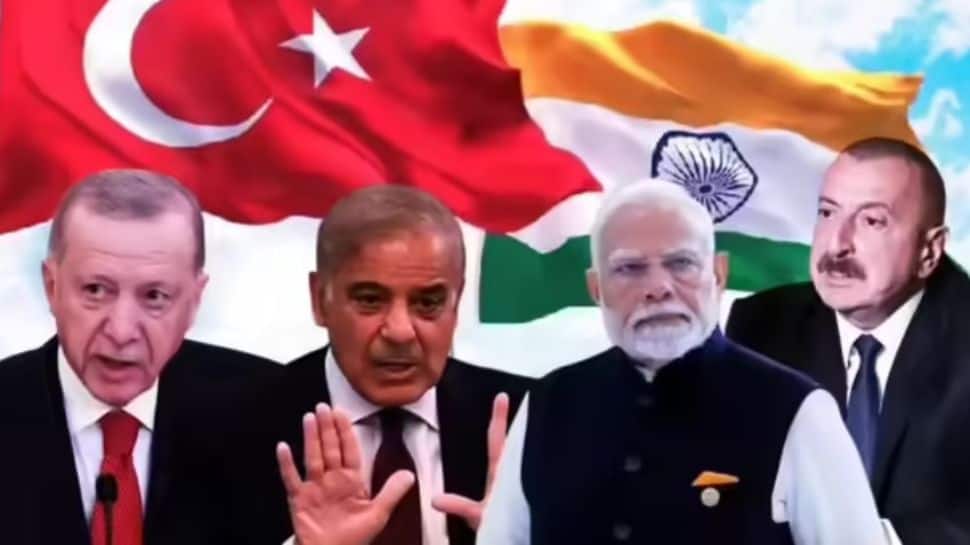
A noticeable geopolitical rift is widening between India and an emerging axis of Turkey and Azerbaijan. This divergence is driven by a confluence of historical relationships, regional power plays, and recent geopolitical shifts. Despite existing economic ties, both Ankara and Baku are increasingly prioritizing actions that diverge from or actively oppose New Delhi’s strategic interests.
Turkey’s stance, particularly its robust support for Pakistan, has been a major point of contention. Following India’s ‘Operation Sindoor’—which targeted nine terror sites in Pakistan-administered Kashmir after a deadly attack—Ankara publicly condemned India’s actions. President Erdoğan of Turkey voiced solidarity with Pakistan’s Prime Minister, commending Islamabad’s reaction and offering diplomatic support. This move prompted a sharp response from India’s Ministry of External Affairs, urging Turkey to curb its support for cross-border terrorism and take concrete steps against terror ecosystems.
The ‘Islamic solidarity’ narrative between Turkey and Pakistan is not new. Turkey has historically backed Pakistan on the Kashmir issue, fostering strong military cooperation. Turkish-manufactured drones have become a particular concern for India, with reports indicating their use in infiltration attempts. India has also recovered advanced Turkish drones from conflict zones, highlighting the flow of foreign military technology into adversarial hands.
Azerbaijan has mirrored Turkey’s position, expressing condemnation of India’s military actions and calling for restraint. This alignment is deeply intertwined with the broader strategic pact between Turkey and Azerbaijan, formalized by the 2021 Shusha Declaration. This agreement fosters joint defense capabilities, military exercises, and economic integration, including the ‘Middle Corridor’ initiative.
The animosity from Azerbaijan towards India is partly fueled by New Delhi’s growing defense ties with Armenia, Azerbaijan’s adversary in the Nagorno-Karabakh conflict. India’s supply of sophisticated defense systems to Yerevan is viewed as a direct challenge by Baku.
The ‘Three Brothers’ alliance, a loose trilateral framework comprising Turkey, Azerbaijan, and Pakistan, is solidifying. This bloc engages in coordinated diplomatic efforts, joint military drills, and mutual support for regional claims, presenting a united front that complicates India’s strategic calculus.
Consequences for India have been swift and multifaceted. Public backlash has led to travel boycotts and calls for economic sanctions against Turkey and Azerbaijan. India has taken economic countermeasures, such as revoking security clearances for Turkish firms. Diplomatic signals have also been sent, with India emphasizing that bilateral relations require respect for core concerns, a clear reference to Turkey’s ties with Pakistan. Azerbaijan’s accusation of India blocking its SCO membership bid further illustrates the retaliatory dynamics at play.
From a strategic perspective, this alignment allows Turkey to bolster its influence in the Muslim world and assert regional power. For Azerbaijan, it strengthens its geopolitical alliances and counters India’s growing presence in the Caucasus. India perceives this bloc as a deliberate strategy to limit its influence across South Asia, Central Asia, and the Caucasus.
The ongoing confrontation is not merely rhetorical. It is built on formal agreements and institutionalized cooperation, intensified by recent India-Pakistan tensions. India is actively seeking to counterbalance this axis by deepening ties with Armenia and other regional partners, but the geopolitical friction with Turkey and Azerbaijan remains a significant strategic challenge.