

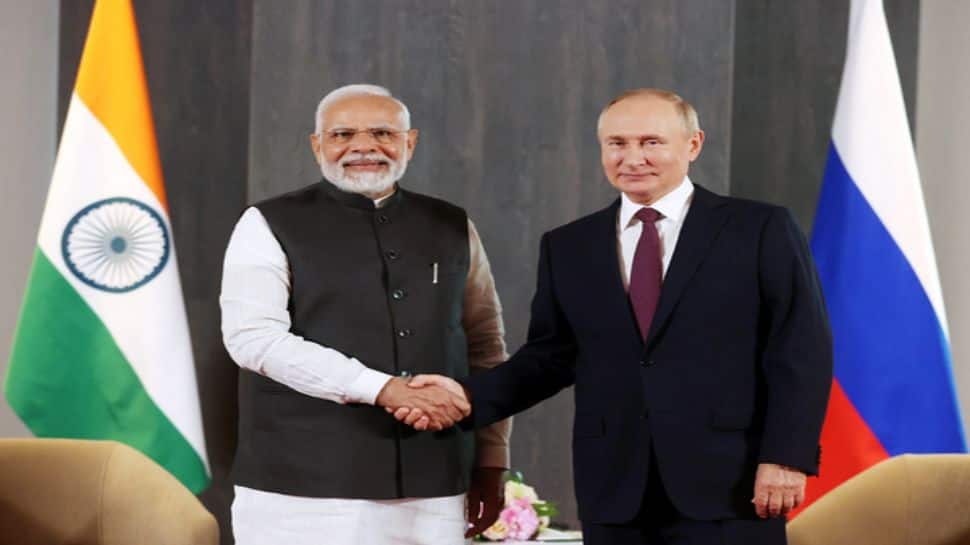
As President Vladimir Putin prepares for his visit to India, Moscow has publicly declared its commitment to significantly strengthening bilateral ties, effectively inviting New Delhi to determine the future trajectory of the relationship. Russia has expressed a clear willingness to move their partnership beyond conventional limits, provided India is equally prepared.
The message was conveyed by Dmitry Peskov, President Putin’s spokesperson, who noted that Russia’s cooperation with China has expanded substantially and that Moscow views India through a similar lens. He stated that the depth of the Russia-India relationship would ultimately hinge on India’s own willingness to foster deeper engagement.
“Our approach with India is the same. As far as India is ready to go, we are prepared to go that far,” Peskov remarked, highlighting Moscow’s readiness for an expansive partnership. He recognized the pressures India might be under regarding its engagement with Russia and stressed the importance of safeguarding their bilateral trade and relationship from third-country influences.
President Putin had also previously articulated his ambition to elevate relations with both India and China to a “new height.” This strategic alignment of statements has led observers to believe that Russia is actively seeking to counterbalance its growing reliance on Beijing by positioning India as an equally significant strategic partner. Such a development could reshape the Asian geopolitical map, impacting everything from international diplomacy to energy markets.
The offer presents India with a strategic challenge. While Russia seeks a partnership of similar depth to its one with China, India’s foreign policy is characterized by its commitment to strategic autonomy. New Delhi aims to maintain strong relationships with multiple global powers, including the United States, which is crucial for its development and technological needs. India’s engagement with Russia is primarily focused on defense and energy imports, a significant portion of which has been discounted Russian oil. However, the trade balance remains heavily skewed, and recent discounts on Russian crude have narrowed, impacting India’s cost savings. India must now navigate these complex dynamics as it decides how to respond to Russia’s ambitious proposal.