

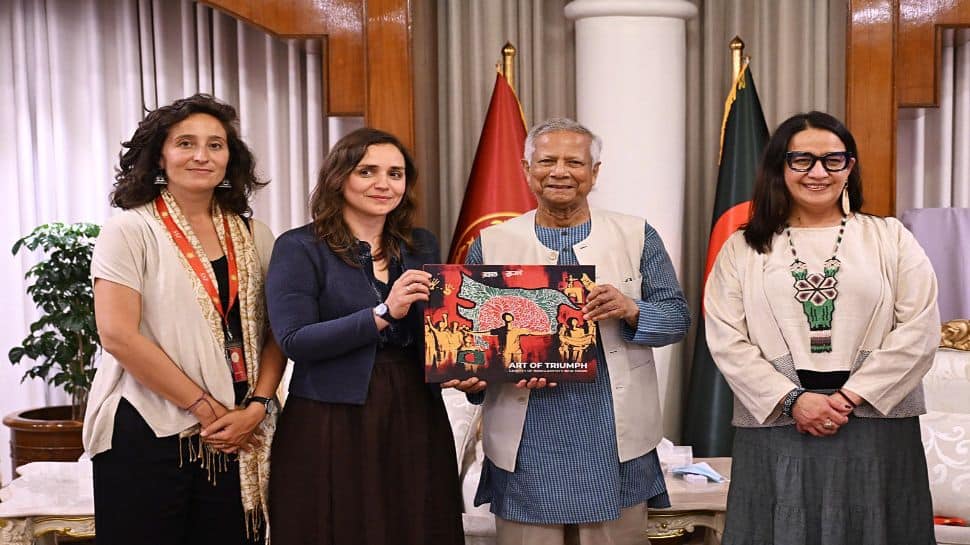
A piece of artwork described as ‘Art of Triumph,’ which depicts a ‘Greater Bangladesh’ incorporating parts of India, has been presented by Bangladesh’s Interim Chief Adviser Muhammad Yunus to a visiting Turkish parliamentary delegation. This marks the second high-profile sharing of the artwork, after a previous presentation to a senior Pakistani military official. Unconfirmed reports from intelligence circles suggest the document included strategic planning elements, such as ‘battle plans’ and ‘post-victory management’ strategies, with Assam identified as a potential territory for Dhaka’s influence.
The controversial artwork, which has generated significant discussion, was also previously shown to Nurul Izzah Anwar, a key figure in Malaysia’s People’s Justice Party, and members of the UN Working Group on Enforced or Involuntary Disappearances. It visually represents a concept of an expanded Bangladesh, explicitly including India’s northeastern states, with a specific focus on Assam.
Officials privy to the situation believe these presentations were calculated moves, intended to communicate with and reinforce ideological connections within transnational Islamist networks that see Bangladesh’s interim leadership as part of a larger strategic agenda. The timing of these disclosures is particularly noteworthy, aligning with Turkey’s increasing diplomatic and defense engagement across South and Southeast Asia. Ankara has been actively expanding its regional footprint through military cooperation, advanced drone technology, and partnerships centered on shared ideologies. Turkish-Bangladeshi relations have seen a significant upgrade since early 2024, with joint training programs, defense industry collaborations, and technology investments.
From Turkey’s perspective, Bangladesh is seen as a vital element in its South Asian strategy, potentially serving as a regional counterbalance to India. For Bangladesh’s current interim leadership, strengthening ties with Turkey offers a pathway to enhanced international credibility and new defense alliances during a period of internal political transition. Experts interpret the ‘Greater Bangladesh’ concept as the interim government’s first explicit territorial statement, possibly aimed at testing international responses and consolidating support from Islamist constituencies abroad and within Bangladesh. India’s security apparatus is closely observing these developments, viewing the narrative as a potential source of heightened regional tensions.