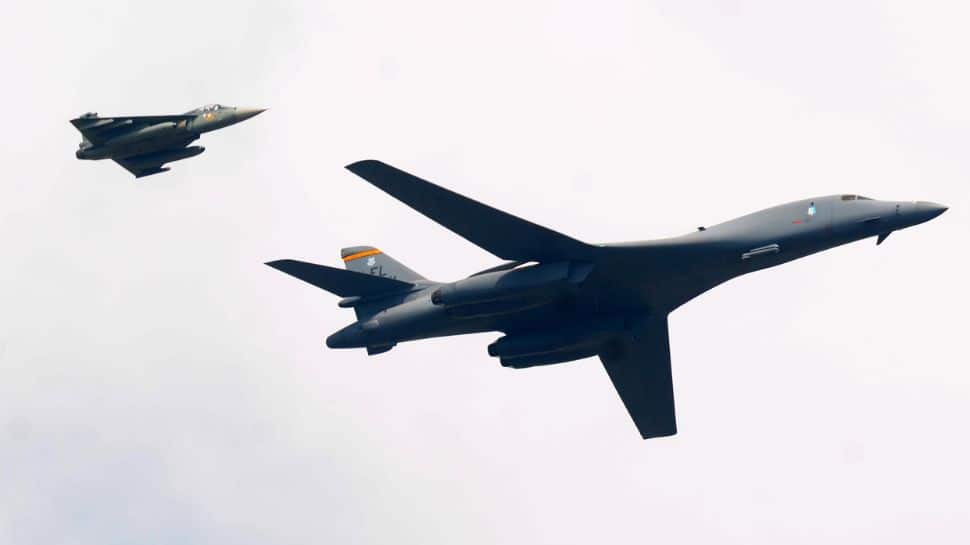
The B-1B Lancer stands as a testament to enduring military technology, a supersonic bomber that continues to dominate the skies decades after its introduction. Known for its ability to fly at speeds greater than sound, this aircraft is a vital component of U.S. air power, frequently deployed to demonstrate dominance and deter potential threats. Its recent flights near Venezuela and Caribbean islands highlight its strategic importance in countering regional challenges, including the fight against drug trafficking. The Lancer’s presence serves as a potent symbol of unwavering U.S. military reach. What makes the B-1B Lancer so effective is its innovative variable-geometry swing wings. This design allows the aircraft to reconfigure its wings in flight – extending them for better lift during takeoff and sweeping them back for reduced drag and enhanced speed during supersonic flight. This adaptability is crucial for its aggressive flight profiles and evasion capabilities. Complementing its aerodynamic prowess is a robust airframe designed for longevity, supported by a sophisticated control system that mitigates the stresses of high-speed flight. The heart of the Lancer’s power lies in its quartet of potent turbofan engines, capable of pushing the bomber beyond Mach 1.2. This immense power, combined with its extensive range, allows the B-1B to operate across vast distances, projecting force wherever necessary. A key tactical advantage of the B-1B is its ‘death from below’ capability, meaning it can fly at extremely low altitudes. Its advanced navigation and sensor systems allow it to remain concealed from enemy radar until the last moment, delivering devastating payloads with little warning. This low-level penetration, coupled with its ability to launch advanced long-range and hypersonic weapons, effectively neutralizes traditional air defense systems and enemy interceptors.
Supersonic B-1B Bomber: The U.S. Air Force’s Enduring Powerhouse
 By The Chhattisgarh2 Mins Read