

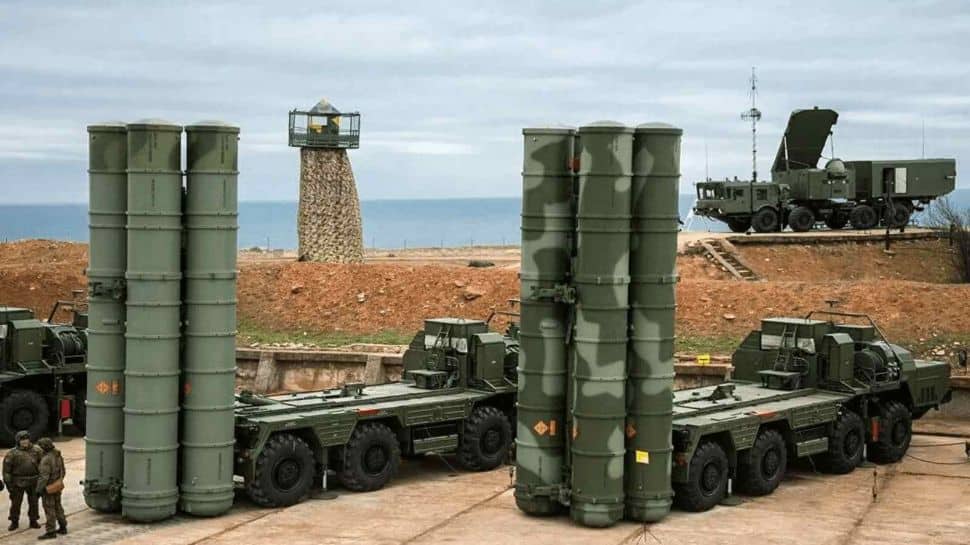
India is closely evaluating Russia’s state-of-the-art S-500 missile system, a development that could dramatically enhance its already robust air defense posture. Currently, India relies on the highly effective S-400 system, a proven shield against a wide array of aerial threats. The S-500, also referred to as Prometheus, promises to push the boundaries further, offering capabilities to intercept faster, higher, and more sophisticated targets, including potentially objects in low-earth orbit.
The S-400 system, acquired by India in 2018, plays a pivotal role in safeguarding Indian airspace. It operates as a mobile, layered defense network, employing various interceptor missiles to protect high-value assets from aircraft, cruise missiles, and certain ballistic threats. Experts highlight the S-400’s significant regional air defense contribution and its demonstrated reliability.
In contrast, the S-500 is designed as a next-generation system focused on countering the most advanced threats. Its operational envelope extends beyond the S-400, specifically targeting hypersonic glide vehicles and long-range ballistic missiles. Publicly available information suggests the S-500 can engage targets in low-earth orbit, effectively extending air and missile defense into near-space. Interceptors for the S-500 are reportedly capable of ranges between 500 to 600 kilometers and altitudes reaching tens to over a hundred kilometers, depending on the target.
This advanced system is described as a theatre anti-ballistic missile defense solution with distinct counter-hypersonic capabilities. While the S-400 excels at intercepting fighters, bombers, UAVs, and tactical ballistic missiles, the S-500 broadens the spectrum to include extremely high-speed ballistic and hypersonic threats. Its potential to engage low-earth orbit objects could grant India a strategic advantage in space defense, though such capabilities remain classified.
Technologically, the S-500 features advanced radar and command and control systems that surpass the S-400’s offerings. These next-generation sensors provide wider frequency coverage, reduced reaction times, and enhanced tracking of high-altitude targets. This allows for simultaneous engagement of multiple fast-moving threats. A key difference lies in interceptor technology: while the S-400 relies on proximity-fused warheads, the S-500 incorporates ‘hit-to-kill’ kinetic interceptors, which are essential for neutralizing high-velocity threats that can evade proximity detonations.
While the S-400 is a well-established system in India, the S-500 is still being integrated by Russia. An Indian acquisition would be a major geopolitical development, requiring extensive negotiations. If procured, the S-500 would significantly augment India’s defense against the most advanced aerial threats, extending its protective shield into near-space and solidifying its position as a formidable defense power.