

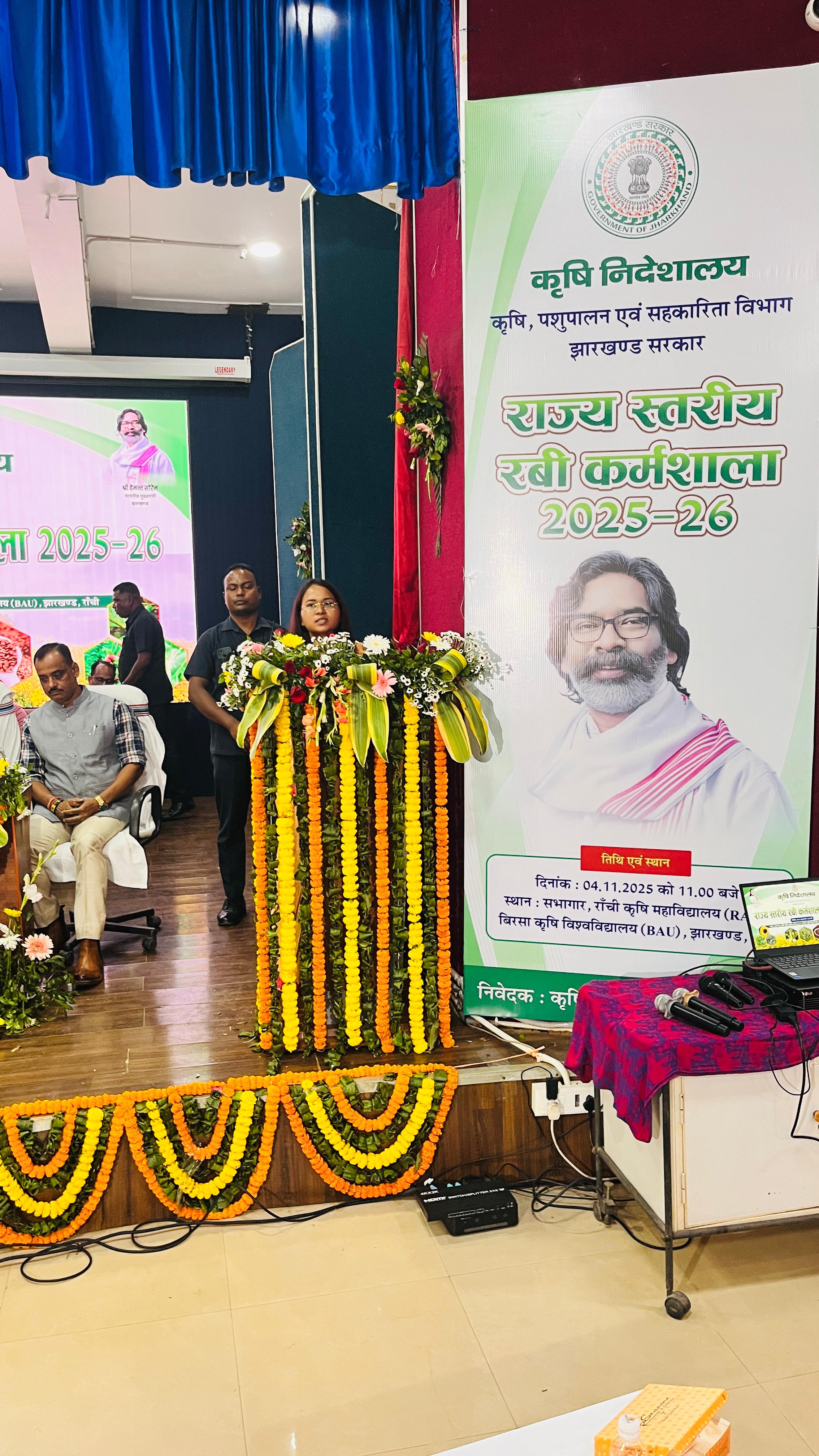
Agriculture Minister Mrs. Shilpi Neha Tirkey said that the state government is committed to the economic development of farmers. This year we expected it to be a good year for farmers, but due to heavy rains, crops have been damaged. The government is assessing the damage and help will be provided to the farmers as soon as possible. She was speaking on Tuesday on the occasion of the Rabi crop workshop organized at Birsa Agricultural University. On this occasion, the Agriculture Minister released the Rabi Workshop book for agricultural information.
Strive towards changing the lives of farmers
Minister Mrs. Shilpi Neha Tirkey, addressing all the District Agriculture Officers and other agriculture officials present at the workshop, said that you should stay in touch with the farmers. Your sensitivity should be with the farmers. She said that you should contact the Block Agriculture Officer, Circle Officer, Panchayat Secretary and bring a list of 200 such farmers from your districts whose lives you have changed, for the upcoming Kharif workshop. She said that the government’s sympathies are with the farmers and the state government intends to reach every farmer in the state, and the role of all of you officials becomes crucial in this. Your stakeholders are farmers. Reflect on how you are providing them with maximum benefits. Provide them with seeds on time. Give them important technical information.
Ensure KCC loans are provided to farmers
Mrs. Tirkey said that the state government’s KCC loan target of 25 lakh has only reached 5 lakh. Try to increase this, provide loans to farmers as per their needs so that they can meet their requirements.
Prepare an agricultural calendar and work according to its timeline
Agriculture Secretary Mr. Abu Bakar Siddiqui said that the main objective of the workshop is to provide farmers with as much information as possible related to Rabi crop cultivation so that their yield increases and they benefit. The calendar for Rabi-Kharif crops should be decided in advance. An agricultural calendar should be active so that activities like seed distribution to farmers happen on time. A timeline should be prepared to check whether the farmer’s farming preparations are happening on time. So that the season is not missed. District Agriculture Officers should make efforts to identify uncovered agricultural areas in the district and make them cultivable. The full potential of agriculture in the district needs to be utilized. Officials will be accountable for whether the resources available in the districts are being used in farming. An integrated approach is very necessary. Where farmers do not farm despite having all the resources, they need to be made aware. Good results mean good production, and good production means good income. Also, provide information about Soil Health Cards to farmers. Take the help of public servants to increase farmers’ productivity. Your government at your doorstep program will run from November 15, the state government’s foundation day. There is a lot of crowd during this time, take advantage of it, make farmers aware, and deliver the best results in Rabi crops.
Vice-Chancellor of Birsa Agricultural University, Dr. S.C. Dubey, said that this workshop will prove very useful in providing information about Rabi crop cultivation to farmers. He explained how crops have been damaged due to heavy rainfall. Remove the damaged paddy and bring in Rabi crops, and explain how the moisture from heavy rains is good for Rabi. Provide quality seeds to farmers and definitely provide information on seed treatment. Utilize the moisture in Rabi cultivation. Advise farmers to cultivate Rabi crops while the soil is moist.
Director, Animal Husbandry, Mr. Zeeshan Qamar, said that this year crops have been damaged due to excess rainfall, but the resulting moisture is beneficial for Rabi crops. This workshop will be helpful in providing technical information to farmers. Provide information about improved varieties of seeds to farmers. Make them aware of modern techniques and provide them with technical information about seed treatment. Workshops like this will be a milestone in providing information about soil health management. Provide information on pest management. District Agriculture Officers will be instrumental in increasing farmers’ productivity.
Registrar, Cooperative Societies, Mr. Shashi Ranjan, said that focus is being placed on how to benefit farmers through the crop insurance scheme. Farmers should pay full attention to the crop insurance scheme. So that compensation can be provided if crops are damaged due to weather.
Director Horticulture, Mrs. Madhavi Mishra, said that this workshop focuses on the upcoming Rabi crop cultivation. The government is serious about agriculture. It is ready to implement all schemes on the ground. The damage to crops due to heavy rains this year is being assessed. The government’s goal is to focus on increasing production and producers, as well as increasing farmers’ income.
Special Secretary, Agriculture Department, Mr. Pradeep Hajari, said that we are always prepared for drought, but this year there has been heavy rainfall, and crops have also been damaged. Now we all have to recover from this and inform farmers that the weather is very good for Rabi crops now, and good yields are expected. Steps should be taken to provide all information to farmers on what measures to take to protect Rabi crops from damage.
Technical Session
Dr. Arun Kumar of Birsa Agricultural University shed light on oilseed cultivation. This year there has been a lot of rain, and it has continued for a long time, and paddy crops are still in the fields. Oilseeds are cultivated in 6.22 lakh hectares across the state, and coverage is to be 86 percent. A translation crop calendar will have to be prepared for Kharif. He emphasized farming based on zero-cost technology and explained how oilseed cultivation can be increased. He also stressed adopting seeds like Birsa Baba Mustard-1 and other varieties. He shed light on how farmers can do advanced cultivation of Rabi crops to achieve maximum yield.
Dr. Kamlesh Kumar of Birsa Agricultural University spoke about the advanced cultivation of chickpeas. He advised sowing seeds on time. Select improved varieties of seeds. Select seeds that mature in 120-130 days. Advise farmers to keep costs low and maximize yield. Apply one irrigation before flowering and one irrigation after pod formation.
Dr. Surya Prakash of Birsa Agricultural University spoke about the advanced cultivation of wheat. We can cultivate wheat as a contingency crop from the first week of November to the last week of December. We have good quality varieties that can give good yields even with less water. Where chickpea and mustard cannot be sown, wheat can be cultivated. Information about wheat varieties was also provided.
Officials from the Agriculture Department, BAU officials, and all District Agriculture Officers were present on this occasion.