

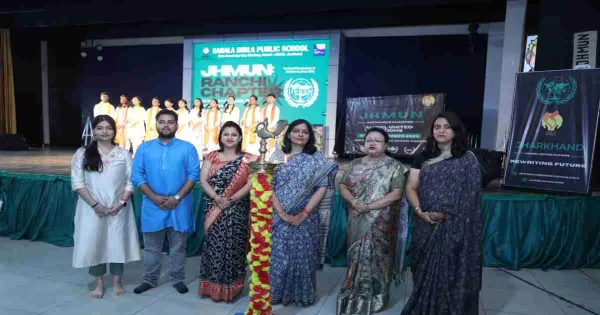
Ranchi: The prestigious Jharkhand Model United Nations (MUN) 2025 commenced its two-day run at Sarla Birla Public School on Saturday, drawing participation from 55 schools statewide. The event is designed as a vibrant platform for honing diplomatic acumen, leadership qualities, and global awareness among students. Its inauguration was marked by a traditional lamp-lighting ceremony, setting a formal tone for the proceedings.
Following the inauguration, an orientation session acquainted the young delegates with the intricacies of parliamentary debate, committee frameworks, and the rules governing their discussions. To build camaraderie and confidence, interactive activities, group dialogues, and skill-building workshops were organized. The core of the event saw students actively participating in spirited debates, caucuses, and the drafting of resolutions, representing diverse nations and tackling pressing global and domestic concerns.
Simulated committees addressed a wide array of critical subjects. The World Trade Organization (WTO) committee examined the escalating global trade disputes and their ramifications for the established global trade order. The United Nations Security Council (UNSC) engaged in a rigorous debate concerning the justification of unilateral military actions undertaken in the name of humanitarian assistance. In the Lok Sabha simulation, delegates analyzed the multifaceted impact of the Armed Forces Special Powers Act, 1958 (AFSPA) on civil liberties, the principles of the rule of law, and the socio-political landscape of regions like Jammu & Kashmir and the Northeast.
Simultaneously, the Jharkhand Legislative Assembly simulation focused on measures to curb illegal mining, referencing pertinent legislation such as the Mines and Minerals (Development and Regulation) Act, 1957 (MMDR Act, 1957), and existing state policies. The United Nations General Assembly (UNGA), despite opposition from delegates representing Palestine, Sudan, and the USA, strove to strengthen international justice and improve the enforcement capabilities of international judicial bodies like the ICC and ICJ. The All India Press and Publication Media (AIPPM) committee critically assessed the Broadcasting Services (Regulation) Bill 2023 and its potential impact on freedom of speech in contemporary Indian media. The International Press Corps (IPC) group focused on professional conduct and regulatory frameworks for photographers, journalists, and cartoonists. The Indian Premier League (IPL) committee engaged in a discussion surrounding the IPC Mega Auctions 26.
Students from Sarla Birla Public School demonstrated remarkable leadership, collaborative spirit, and analytical thinking as they interacted with their counterparts from across Jharkhand. Their proposals offered forward-thinking solutions to complex global issues. The school grounds were alive with intellectual discourse, fostering an environment where students were encouraged to think deeply, act responsibly, and embrace a global perspective.
The school’s Principal, Manisha Sharma, lauded the dedication of the student organizers, delegates, and faculty advisors. She highlighted how Model UN programs are instrumental in developing diplomatic skills, communication prowess, and a broader worldview. Expressing a warm welcome to all participants and educators, she urged students to engage actively, contribute to constructive debates, and devise innovative, practical solutions for global challenges. She concluded by emphasizing that such events are crucial for nurturing essential qualities like diplomacy, critical thought, leadership, and effective communication, thereby preparing students to become influential change-makers.