

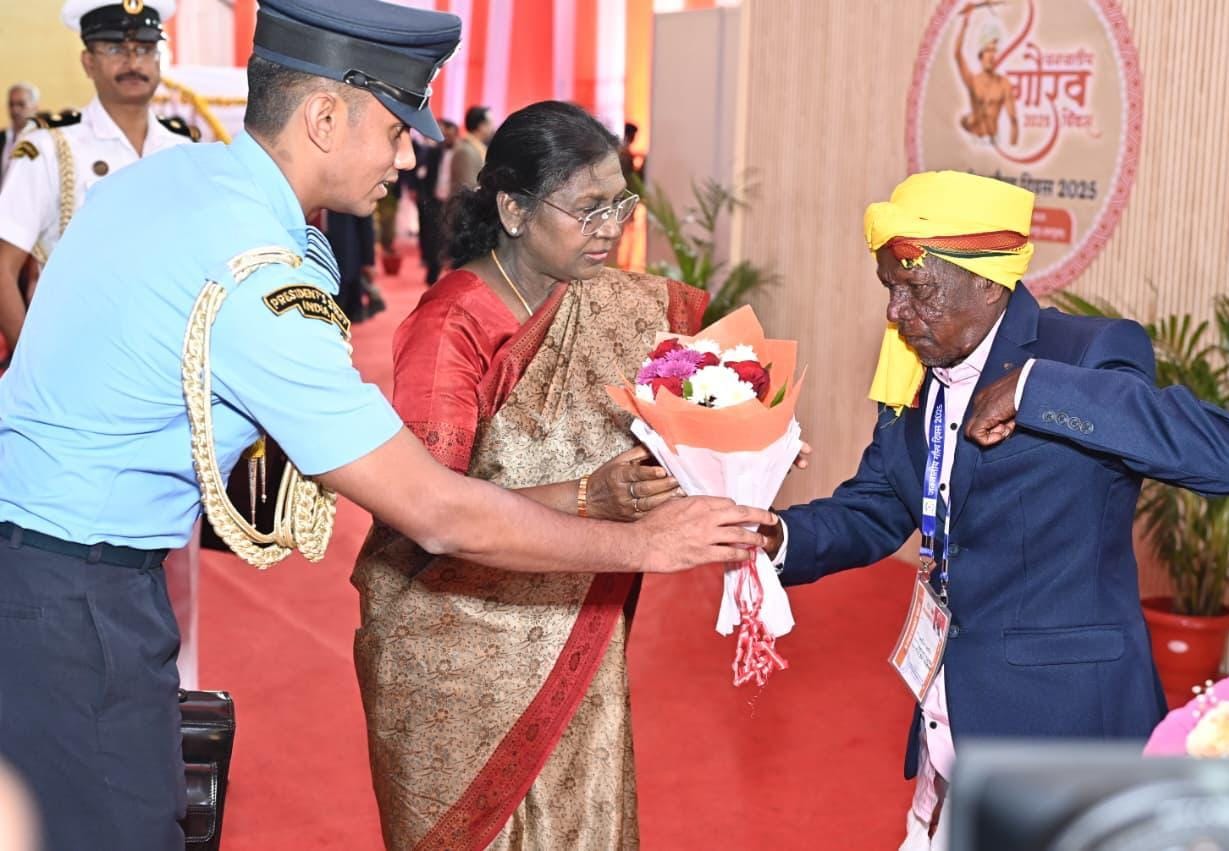
President Smt. Droupadi Murmu participated as the chief guest in the program organized in Surguja district.
President reviewed the stalls showcasing tribal culture and handicrafts.
Worshipped deities in the models of traditional Akhara and Devgudi.
Kalinder Ram presented a pairi and gamcha to the President.
November 20, 2025/ President Smt. Droupadi Murmu participated as the chief guest in the program organized at PG College Ground in Surguja district on November 20, on the occasion of Tribal Pride Day 2025. Governor Shri Ramesh Dekha, Chief Minister Shri Vishnu Deo Sai, Union Minister of State for Tribal Affairs Shri Durga Das Uike, Union Minister of State for Housing and Urban Affairs Shri Tokhan Sahu, Minister of Tribal Affairs Development, Agriculture Development and Farmer Welfare Shri Ramvichar Netam, In-charge Minister District Surguja and Minister of Finance Commercial Tax Shri Omprakash Chaudhary, Minister of Tourism Culture and Religious Trust Shri Rajesh Agarwal, Minister of Forest and Climate Change Transport Cooperation and Parliamentary Affairs Shri Kedar Kashyap, Minister of Public Health and Family Welfare Medical Education Backward Classes and Minority Development 20-Point Program Implementation Shri Shyam Bihari Jaiswal, Minister of Women and Child Development Social Welfare Department Smt. Lakshmi Rajwade, Surguja MP Shri Chintamani Maharaj, North Raipur MLA Shri Purandar Mishra, Jagdalpur MLA Shri Kiran Singh Dev, Mayor Ambikapur Smt. Manjusha Bhagat were also present in the program.
Exhibitions were organized at the program venue to display tribal culture, folk art and crafts, jewelry and attire, worship, rituals, cuisine, musical instruments, herbs, etc. President Smt. Murmu reviewed the exhibitions.
Worshipped Deities at Traditional Akhara Site and Devgudi, the center of tribal religious faith.
In the program, after observing the models of the traditional Akhara site of the tribes and Devgudi, the center of religious faith of tribal inhabited villages, deities were worshipped.
Akhara is a cultural site of the tribes residing in the Surguja region of Chhattisgarh state, located in the middle or at the crossroads of villages, often surrounded by clusters of shady trees. Villagers gather collectively on occasions of various folk festivals like Karma, Mahadev Bayar, Teeja Athe, Jivatiya, Sohrai, Dasai, Fagua, and celebrate with enthusiasm by singing folk songs and performing folk dances to the beat of traditional musical instruments. Tribal community members presented traditional dances at the exhibition. Devgudi, the center of religious faith of tribal inhabited villages, is known in the state by various regional names such as Devala, Devavalla, Mandar, Sheetla, Sarna, etc. Deities like Budhadev, Budhidai, Sheetla, Sarnadev, Deehvarin, Mahadev, etc., reside in Devgudi. On the occasions of various tribal folk festivals, villagers gather collectively and, led by the Baiga, perform worship and pray for the peace, prosperity, and well-being of the village.
Reviewed Housing Models Made of Mud and Wood.
A model of traditional housing of tribes residing in Chhattisgarh was made at the program venue. The President also reviewed the housing model. Tribal housing is made of mud and wood, with one or two rooms and a verandah in front of the main room. The roofs are covered with sloped tiles. One room is used as a kitchen, where kitchen utensils and household items are kept, and the other room is used as a bedroom. The verandah contains other household items such as Dheki, Musal, Sil-Batta, Janta, etc.
Exhibition of Ornaments Worn by Tribes During Various Folk Festivals and Events, Kalinder Ram Presented Pairi and Gamcha to the President.
During this, an exhibition of traditional ornaments of the state was organized. President Smt. Droupadi Murmu reviewed the exhibition and took information about the ornaments. Shri Kalinder Ram presented a pairi and gamcha to the President, which the President accepted with affection. Shri Kalinder Ram informed the President that traditional ornaments are made of metals like gilt, copper, silver, gold, etc., which are worn on the occasion of various folk festivals. During this, Hasuli worn around the neck, Bahuta on the arm, Ainthi on the wrist, Rupaya wala Chandwa around the neck, Kamarbandh on the waist, Pairi on the feet and Bichhiya on the toes, Thotha in the ear, and Chhuchhiya (Phuli) worn in the nose were displayed.
Exhibition of Musical Instruments.
Musical instruments played by tribes for entertainment during folk festivals were displayed in the exhibition. The President viewed these musical instruments. Tribes residing in the state play Tat, Avannaddha, Ghan, and Sushir instruments for enthusiasm, whose sweet sounds are a sight to behold during festive occasions. There are many such instruments whose sounds resonate for miles and inspire people to dance spontaneously. In the Surguja and Bastar regions, the sounds of musical instruments can be heard continuously for many months. It is due to these musical instruments that the rich cultural heritage of the tribes remains alive even today. Instruments like Mandar, Dhol, Jhanjh, Majira, Tambura, Sarangi, Khanjari, Bansuri, Chaurasi, and Paijan, played by the tribes of the Surguja region during various folk festivals, have been displayed.
Herbs Used by Tribal Communities in Treatment Displayed.
Herbs used by the tribes residing in the state for the treatment of physical ailments were displayed in the exhibition organized at the program venue. Ashwagandha, Kulanjan, Mulethi, Safed Musli, Giloy, Lal Jhimti, Arjun Bark, Pisiya, Bhuichampa, Gokharu, Kutaj Bark, Gudman Leaf, Viraita, Rohine Bark, Balamkhira, Harra and Behda, seeds of large tamarind, Harsingar, Akarakara, Chirai Gudi, Shilajit, and Balraj, etc., were kept in the exhibition. They inhabit forest regions, hills, valleys, and plains. Various types of medicinal plants, roots, and vines are found in their habitats. People of the tribal community treat their physical ailments using these wild herbs. Vaids, Baigas, Guniyas, and Hathjod of the tribal community treat people hereditarily.
Traditional Cuisine and Tubers.
An exhibition of dishes prepared by tribal communities during festivals and other occasions was organized. Various types of bread, chutneys, kohri (vadi), laddus, etc., were displayed here. Tribal women prepare dishes from naturally available ingredients and collect various types of tubers, fruits, and flowers from the forests for consumption. During this, Kandapitharu Kanda, Dang Kanda, Nakwa (Churka) Kanda, Sakhein Kanda, etc., were displayed.