

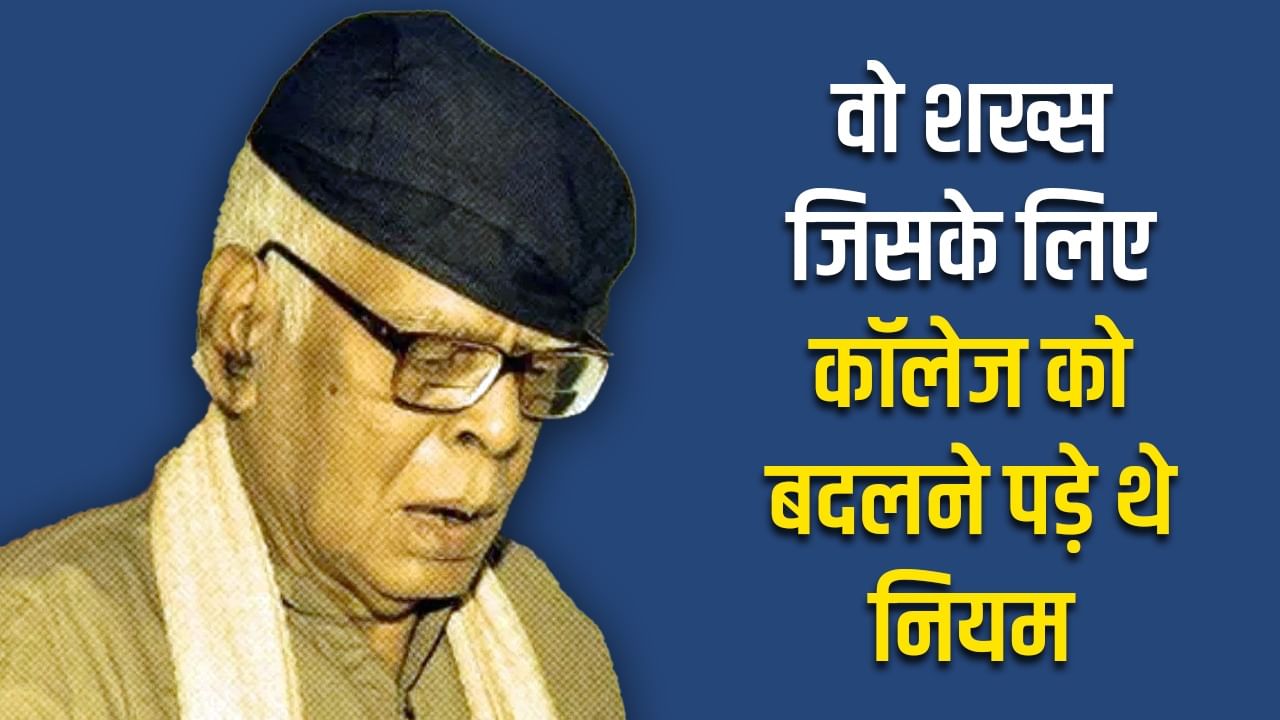
Vashishtha Narayan Singh, a name synonymous with mathematical brilliance, hailed from the Bhojpur district of Bihar, a region that has gifted India with numerous luminaries. Born in 1942, Singh’s exceptional intellect shone through from a young age, earning him the moniker ‘Chanakya of Mathematics’ and the respect of the scientific community.
His academic journey began in the modest village of Basantpur, where he excelled despite facing financial constraints. Singh’s prowess was evident early on, as he topped the Bihar state in his 10th-grade examinations. This led him to Patna Science College, where his extraordinary abilities drew widespread attention. An anecdote from his BSc days illustrates his remarkable grasp of complex concepts; he persuaded the university to allow him to directly take the final year exams, bypassing the standard three-year curriculum, a testament to his unparalleled understanding.
Further cementing his reputation, Singh’s sharp eye caught a professor’s error during a math class, leading to a challenge that he met with ease, solving the problem in multiple ways. This event resulted in his advancement from first to third year. His talents extended beyond the local scene, reaching the United States where he was noticed by John Kelly, a prominent mathematician at the University of California. In 1965, Singh moved to the US, earning his PhD in Mathematics in 1969, with his research on Reproducing Kernel Hilbert Spaces garnering international acclaim.
Singh’s career then led him to associate professorship at the University of Washington and a brief stint at NASA. Yet, the allure of America couldn’t compare to his love for India. In 1971, he returned to his homeland, subsequently taking on roles at prestigious institutions like IIT Kanpur, IIT Mumbai, and the Indian Statistical Institute in Kolkata. Tragically, his life took a turn after his marriage in 1973. His behavior became erratic, displaying signs of mental health challenges.
In 1974, a heart attack in Ranchi exacerbated these issues, and the subsequent years were marked by personal struggles. He eventually vanished for five years, only to be rediscovered and admitted to NIMHANS in Bangalore. After treatment, he was discharged, but his health declined again, and he passed away in 2019, leaving behind a legacy of intellectual brilliance and a poignant reminder of the fragility of the human mind.