

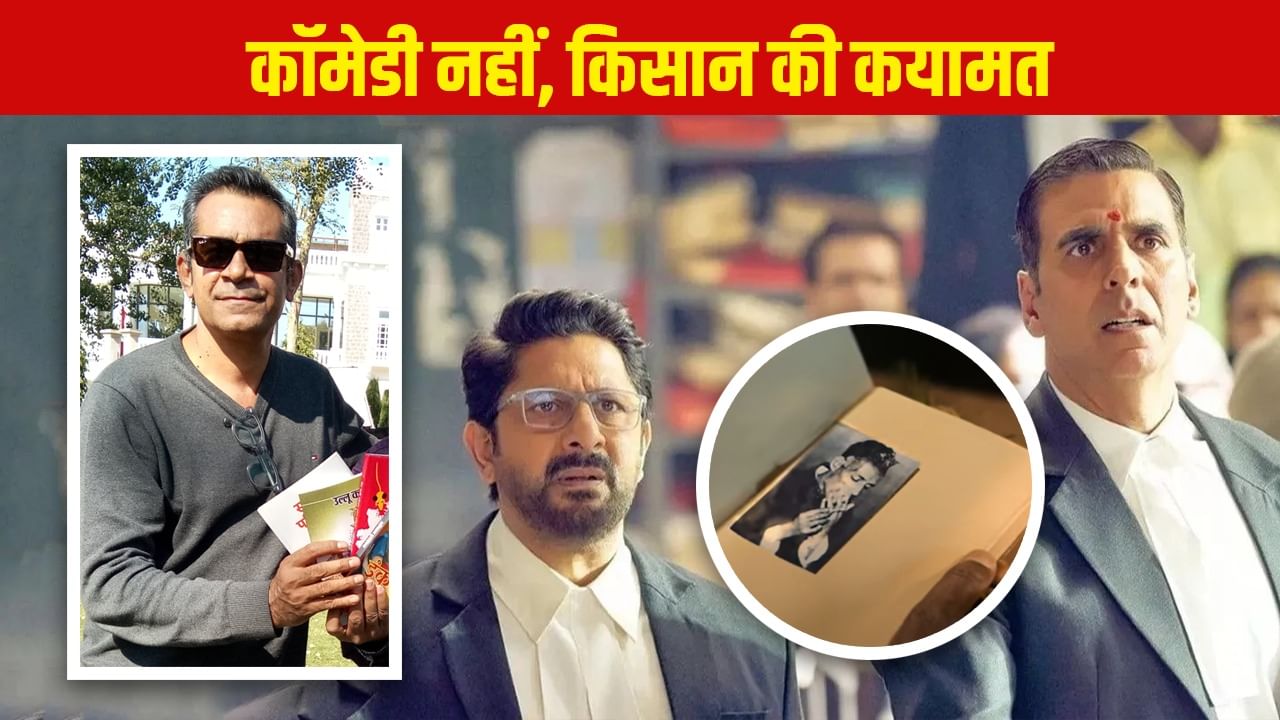
The third installment of Jolly LLB, a cult franchise, sparked intrigue from the trailer’s release. The film’s viewing solidified this curiosity. The trailer prominently featured a picture of poet Muktibodh, which resonated deeply. The question arose: What political message does this film convey? A farmer is seen turning pages, one of which displays a striking image of Muktibodh. This evokes respect and raises the question of Muktibodh’s purpose in the film. What did director-writer Subhash Kapoor intend by including this image? And why include such a profound Hindi poet in a film that is positioned as a comedy?
Beyond the role of the judge, portrayed by Saurabh Shukla, other aspects of the film made me contemplate its seriousness. The film showcases Seema Biswas grieving over her deceased husband’s statue, explores the dynamics between the weak and the powerful, presents a debate between farmers and industrialists, and highlights the judge’s wit. Also referenced are some of Muktibodh’s famous lines: ‘One must take all the risks of expression’ and ‘What is your politics, partner?’ This made me excited to see Kapoor’s political film disguised within a comedy, prompting me to understand the director’s perspective and the writer’s message.
In the realm of Hindi literature, Muktibodh is celebrated for his depictions of life’s complexities. He is regarded as Hindi’s most realistic and progressive poet. He boldly stated in the sixties, ‘The moon’s face is crooked,’ challenging conventional beauty standards. This was a critique of those who romanticized the moon, and generations were captivated by their vocabulary. However, Muktibodh was the only poet who brought the moon down to earth, highlighting the realities of farmers and the working class. He wrote of ‘the crooked-faced moon’s trickery’ and ‘the shadows of the moon… Oh, moonlight is also very mischievous…’
Muktiibodh wrote, ‘Now one must take all the risks of expression, break the monasteries and forts…’ His writings were a proclamation of light against darkness. As we watch Jolly LLB 3, we are reminded that Muktibodh’s message remains relevant. In a time when values are shifting, and a new dawn is appearing, the film’s judge, Saurabh Shukla, addresses both ‘paper’ and ‘spirit’, emphasizing that decisions are often based on ‘paper’. He suggests that a proper understanding of ‘paper’ comes from ‘spirit,’ and true justice requires both.
If the ‘spirit’ had been prioritized earlier, the farmer Raja Ram Solanki’s land would not have been lost to the ‘Bikaner to Boston’ project, and the farmer would not have taken his own life. He initially asserts, ‘My land, my will,’ but later loses his land and pleads with the Tehsildar, saying his son died for the country. But when darkness surrounds him, he takes his own life. In this sequence of loss and struggle, the visuals and sounds deeply affect the audience.
The farmer flips through pages, revealing lines of text. A collage of documents and fragments of text emerges, featuring the image of poet Gajanan Madhav Muktibodh. The familiar image shows him holding a bidi. This image has been a significant part of Hindi literature for many years. It’s said that his works were famous during his lifetime, yet no collection was published. But as time passed, his popularity grew. Seeing Muktibodh in a mainstream Hindi film in 2025 allows the audience to understand the film’s message against the ‘monasteries’ and ‘forts.’ Director-writer Subhash Kapoor deserves full credit.
The lines that are heard during the suicide of the helpless farmer
My roof kept leaking still
I prayed for rain
From my grandfather to my great-grandfather
From my father to my grandfather
And the inheritance I received from my father
I wanted to give the same to my son
Wanted to give a little land
And a handful of seeds so that
Everyone’s hunger could be quenched
That’s why I believed
In all their words
In the sentiments expressed in the speech
I kept watching, mesmerized
Their heads rising towards the sky
And they pulled the ground from under my feet
I was proud to be an Annadata (grain giver)
This was my crime that
I was a farmer.
‘Our land, our will’
The film includes the lines of a poem while this is happening, although it does not explicitly state the poem’s author. Muktibodh is present throughout the scene. The film is inspired by the 2011 events in Bhatta Parsaul village of Uttar Pradesh, but the setting is changed to Rajasthan, while the village name is retained. The film’s central theme is ‘Our land, our will.’ Industrialist Haribhai Khetan (played by Gajraj Rao) employs various tactics to seize the village land for the ‘Bikaner to Boston’ project. The local administration, MLA, and economists are all under his control. However, when farmer Raja Ram Solanki asserts his will, the ‘monasteries’ and ‘forts’ begin to crumble. Akshay Kumar and Arshad Warsi, playing the lawyers, who are jolly and relatively inexperienced, undergo a change of heart after understanding the farmer’s widow’s plight. They then unite against injustice. Meanwhile, the judge, who wants to make his life better, takes the risk of choosing ‘spirit’ over ‘paper’.