

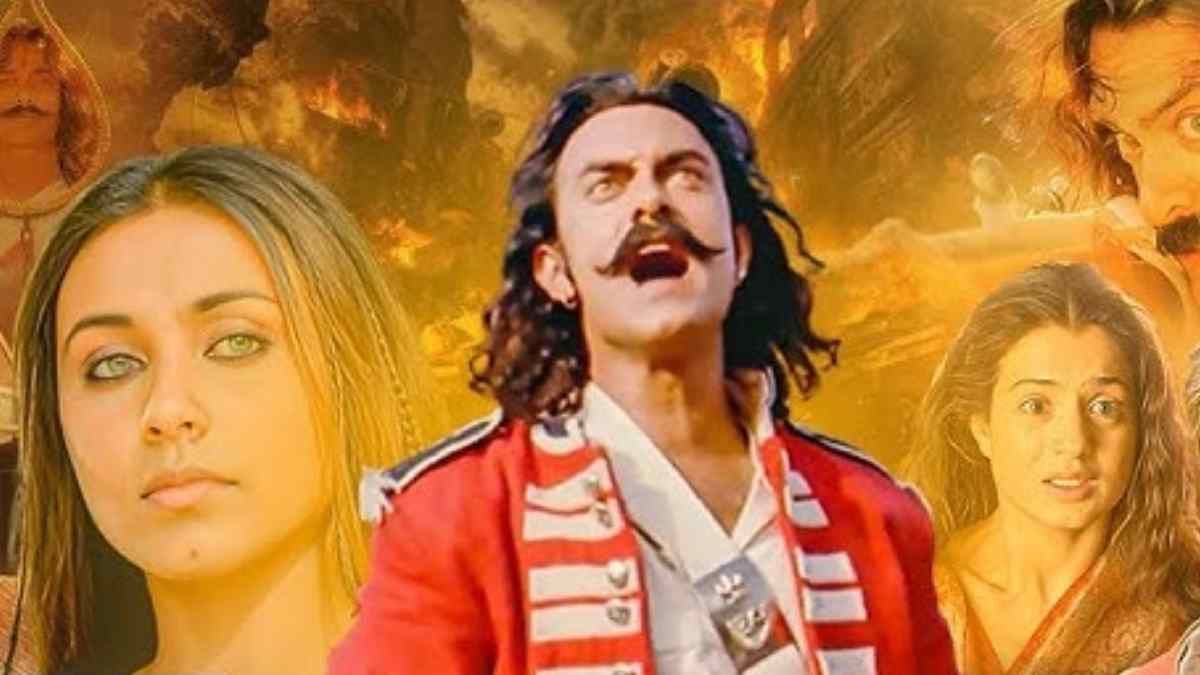
The movie ‘Mangal Pandey’ sometimes feels disjointed, evoking both artificial and sympathetic reactions, occasionally even bordering on the pathetic. The attempt to encapsulate a significant historical moment is broken into distinct, kitschy pieces. A. R. Rahman’s songs don’t save the film from disappointment. Aamir Khan’s portrayal is considered ‘polished.’ With his bronzed appearance, he seems to have been ‘tanned’ with something like boot polish, embodying the character of Mangal Pandey, a key figure in India’s fight against British rule.
The script’s harsh and unpredictable nature often feels more oppressive than the ‘Gora Log’ (white people) in their seemingly off-the-shelf costumes. The British forces in ‘Mangal Pandey: The Rising’ (shouldn’t the title have been ‘The Uprising’?) with their red uniforms, present a parody of uniformed order.
The characters, especially the white ones, lack a sense of real-life depth. Cosmetic depictions of colonialism worked well in Manmohan Desai’s ‘Mard,’ where Bachchan’s character dominated the sneering ‘Gora Log.’
However, this film seemingly expects more nuance from Mehta than is present in its patriotic narrative. The build-up within scenes often feels more important than the final outcome.
Of particular concern is the relationship between Aamir and Rani’s characters. Their romance, resembling the Devdas-Chandramukhi dynamic (he recoils when the prostitute attempts to touch him), is unconvincing.
Rani’s portrayal of the prostitute doesn’t align with historical reality or the film’s overall tone. She moves between being auctioned in the marketplace, to the disgust of a British woman, and then performing a sensual ‘Mujra’ in Madame Kirron Kher’s lavish ‘kotha’ (a nod to Sanjay Bhansali’s ‘Devdas’).
Instead of presenting the prostitute’s character with depth, Rani makes Heera playful… a kind of Babli of the flesh trade.
Amisha Patel’s smaller role as Jwala is surprisingly effective. The scene where the British officer Gordon, alongside Mangal, rescues her from a barbaric Sati ritual is shot in striking colors. She later shares heartfelt moments with her ‘Gora’ rescuer.
More development of the Jwala-Gordon relationship would have been appreciated, instead of the obligatory love scene.
The visuals don’t create a strong narrative. Ironically, Gordon is a more appealing character than Mangal Pandey. The white man’s moral struggle is well-portrayed by Toby Stephens, an actor who deserves more attention. This marks a rare instance where a foreigner in a Hindi film receives applause without the audience understanding what he’s saying!
Aamir’s mustache and bulging eyes do all the work for his historical character. Whether this is due to the script, character development, or the actor, is unclear. Mangal Pandey appears more as a cardboard hero than a genuine independence martyr. His climactic scene, where he bravely takes on the British, is well-shot but marred by editing issues.
The scenes designed to highlight Mangal’s heroism are ludicrous. “I AM Hindustan,” Aamir declares, sounding like a child at play.
Without irony or modesty, Aamir’s Mangal Pandey is a self-important, comic-book hero, obscured by the actor’s failure to blend history and cinematic heroism.
Aamir’s Mangal Pandey feels trapped.
Unlike ‘Lagaan,’ where the hero’s journey led to him becoming the sole focus, Aamir never quite shines in ‘Mangal Pandey.’ He remains in the shadows.
There are many well-dressed supporting actors and junior artists, reflecting nationalist solidarity. Rani Mukerji even rides a horse (to appease distributors?). They seem like afterthoughts from a cricket match in ‘Lagaan.’
The most uncomfortable moments involve vulgarity. A peasant operates a fan for a sleeping British woman with suggestive movements. A man selling the prostitute Heera offers to lower her ‘ghagra’ for better customer satisfaction. The film also overuses revealing scenes.
The story lacks depth. Mehta’s epic vision is appreciated, as is his ability to arrange characters spatially. Nitin Chandrakant Desai’s artwork and Himman Dhamija’s cinematography enhance the look. However, they fail to create the blend of epic and pleasure that makes historical events engaging on screen.
Faroukh Dhondy’s script leans more towards Bollywood than history. Ketan Mehta seems focused on distancing himself from his earlier work by creating a big Bollywood production.
The result is a film that’s more hysterical than historical, more corny than captivating. The film has moments of brilliance, but if you want Mehta’s blend of socio-political themes with color, see ‘Mirch Masala’ or ‘Bhavni Bhavai,’ where folklore and narrative are blended.