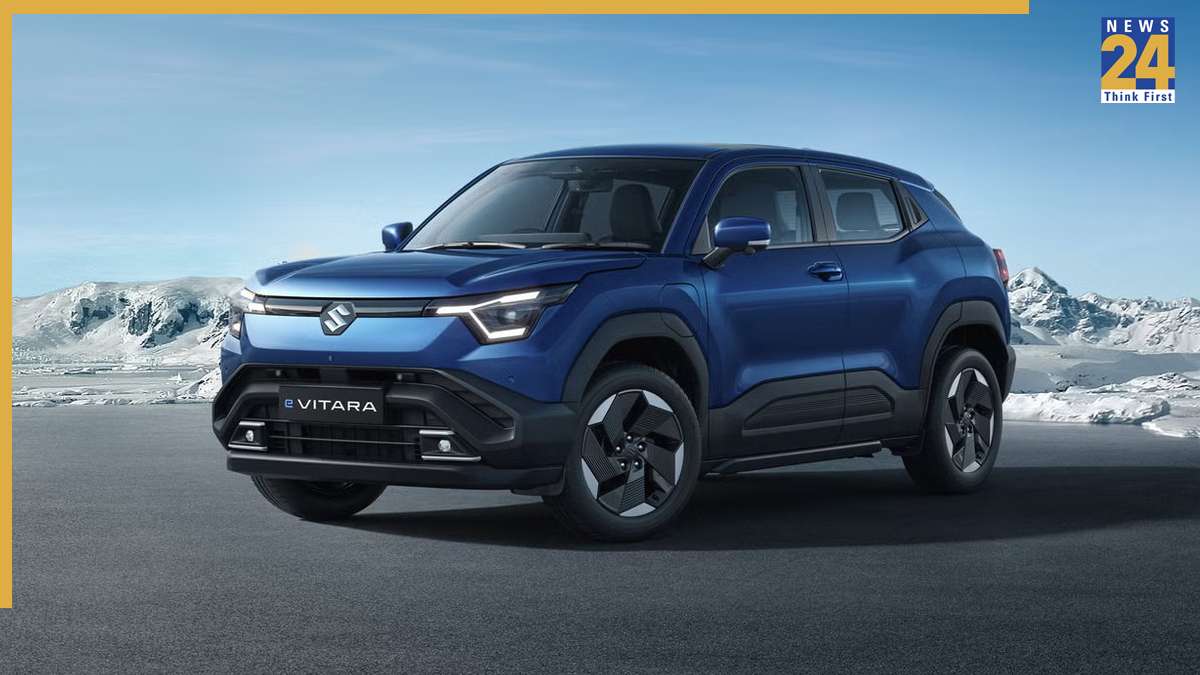
Prime Minister Narendra Modi inaugurated the local production of hybrid battery electrodes at the Suzuki Motor Plant in Ahmedabad, Gujarat, while also initiating the export of the Maruti Suzuki e-Vitara, the company’s first global battery electric vehicle, to more than 100 countries. The e-Vitara made its initial appearance in India at the Bharat Mobility Global Expo in January 2025. Suzuki’s production capabilities are considerable, with four Indian plants able to produce 2.6 million units annually. In FY25, the company exported 3.32 lakh vehicles and sold 19.01 lakh units in the domestic market, highlighting its strong position. Beyond the e-Vitara, models such as the Suzuki Fronx and Jimny have also achieved significant success in international markets. The e-Vitara is poised to compete with vehicles like the Hyundai Creta Electric. The e-Vitara will offer a rear-wheel-drive module in certain trim levels, in contrast to the Hyundai Creta. Details from a previous leak indicate the e-Vitara will feature a 75 kWh battery pack, with all-wheel drive available in the Empowered trim, plus a 12.3-inch screen and ADAS Level 2 safety features. Comparisons are made with the Tata Harrier EV and the Hyundai Creta Electric. The Suzuki e-Vitara, as Suzuki’s first electric vehicle, offers ventilated seats, flexible boot space, and modern features. It is built on the HEARTECT-e platform, designed for EVs to maximize innovation and efficiency. The e-Vitara will use a 61 kWh Lithium-ion battery tested across a wide temperature range (-30°C to 60°C) and is expected to have a range of about 500 km. Estimated prices can be found in a comparative table. The Hyundai Creta EV, a strong competitor, is expected with battery options of 42 kWh and 51.4 kWh, with a claimed range of up to 473 km. However, the Creta EV may lack features and off-road abilities compared to the Tata Harrier EV, classifying it more as a conventional subcompact SUV.
Suzuki e-Vitara Production Launched by PM Modi, Featuring Specs, Rivals, and Detailed Comparisons