

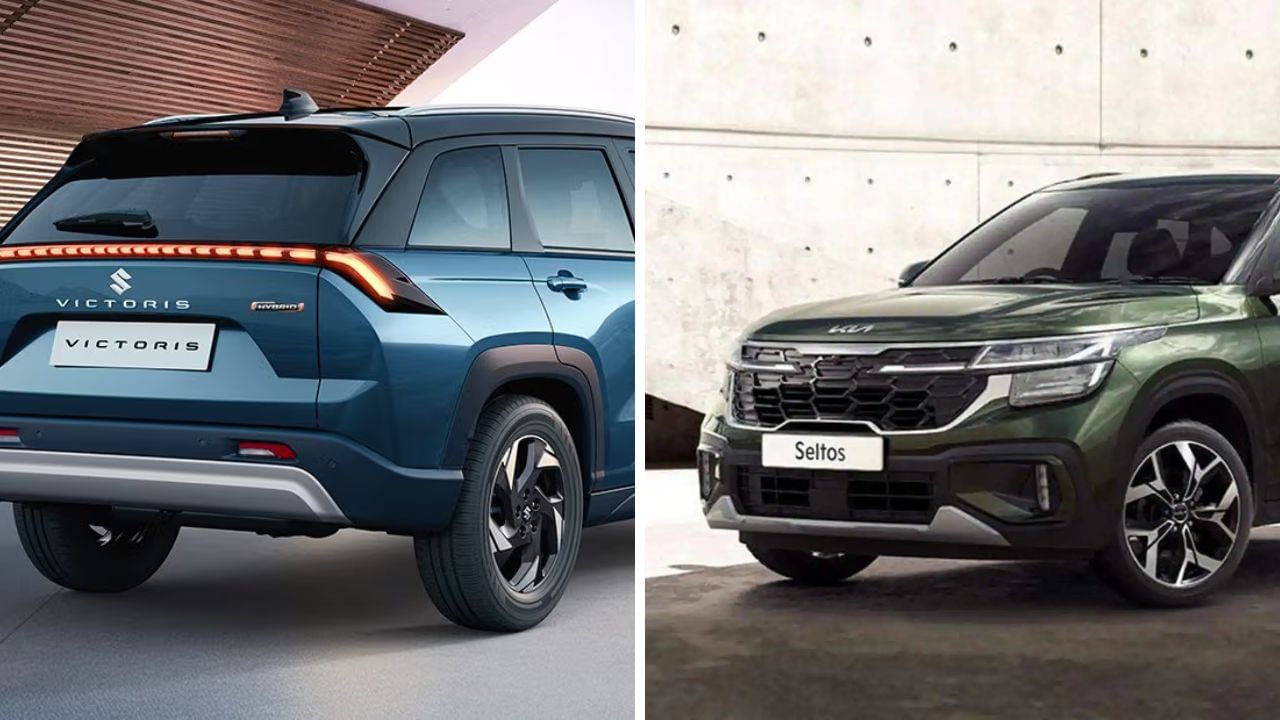
Maruti Suzuki has introduced its new compact SUV, the Victoris, into a highly competitive market. This segment, featuring rivals like the Hyundai Creta and Kia Seltos, sees these SUVs vying for dominance. Both the Creta and Seltos offer diverse engine options, feature-rich interiors, and comprehensive safety features. The Victoris aims to challenge these established players.
Comparing the Victoris to the Seltos, both share similar characteristics within the same segment, yet differences cater to distinct consumer preferences. This analysis explores the variations in pricing, specifications, and safety features.
**Price Comparison**
The Maruti Suzuki Victoris is priced more affordably compared to the Seltos across most of its variants. The base variant of the Victoris is approximately ₹70,000 less expensive than the Seltos. The trend of cost-effectiveness extends to the mid-range variants as well. However, this price advantage diminishes in the higher-end models. The strong hybrid variant of the Victoris is priced around ₹20 lakh, while the GTX+ and X-Line versions of the Seltos are positioned slightly above ₹20.5 lakh. In this premium segment, consumers often prioritize design and upscale features, where the Seltos demonstrates a stronger appeal.
**Specification Breakdown**
Both SUVs provide three engine options for consumers. The Victoris is equipped with a 1.5-liter naturally aspirated petrol engine, a factory-fitted CNG option, and a strong hybrid engine paired with the AllGrip Select AWD system. Conversely, the Seltos features a more potent 1.5-liter petrol engine. The Seltos does not offer CNG or hybrid options, but includes a 1.5-liter turbo-petrol and a 1.5-liter diesel engine. The Victoris distinguishes itself with its CNG and hybrid AWD technologies, while the Seltos emphasizes the performance of its petrol and diesel engine choices.
**Technology and Features**
Both SUVs come equipped with a 10.25-inch display, panoramic sunroofs in their top-tier variants, and connected-car technologies. The Victoris includes a gesture-powered tailgate, 64-color ambient lighting, an Infinity Dolby Atmos 8-speaker system, and over-the-air updates enabled by Suzuki Connect.
In contrast, the Seltos features a dual-screen layout, dual-zone climate control, ventilated seats, and GT/X-Line cosmetic packages. In summary, both SUVs offer a comprehensive array of features. However, the Victoris focuses on connectivity and cabin ambiance, while the Seltos places a greater emphasis on a sporty and premium interior design.
**Safety Features**
The Victoris has been awarded a 5-star safety rating by Bharat NCAP. It boasts six airbags, ESC, a 360° camera, HUD, and Level-2 ADAS tailored for Indian driving conditions.
The Seltos offers Level-2 ADAS features as well, but these are only available starting from the GTX+ variant. In 2020, the Seltos received a 3-star rating from Global NCAP. This suggests that the Victoris offers superior safety and greater ADAS coverage across more of its variants. The Seltos, however, limits its advanced safety features to its higher-end models.