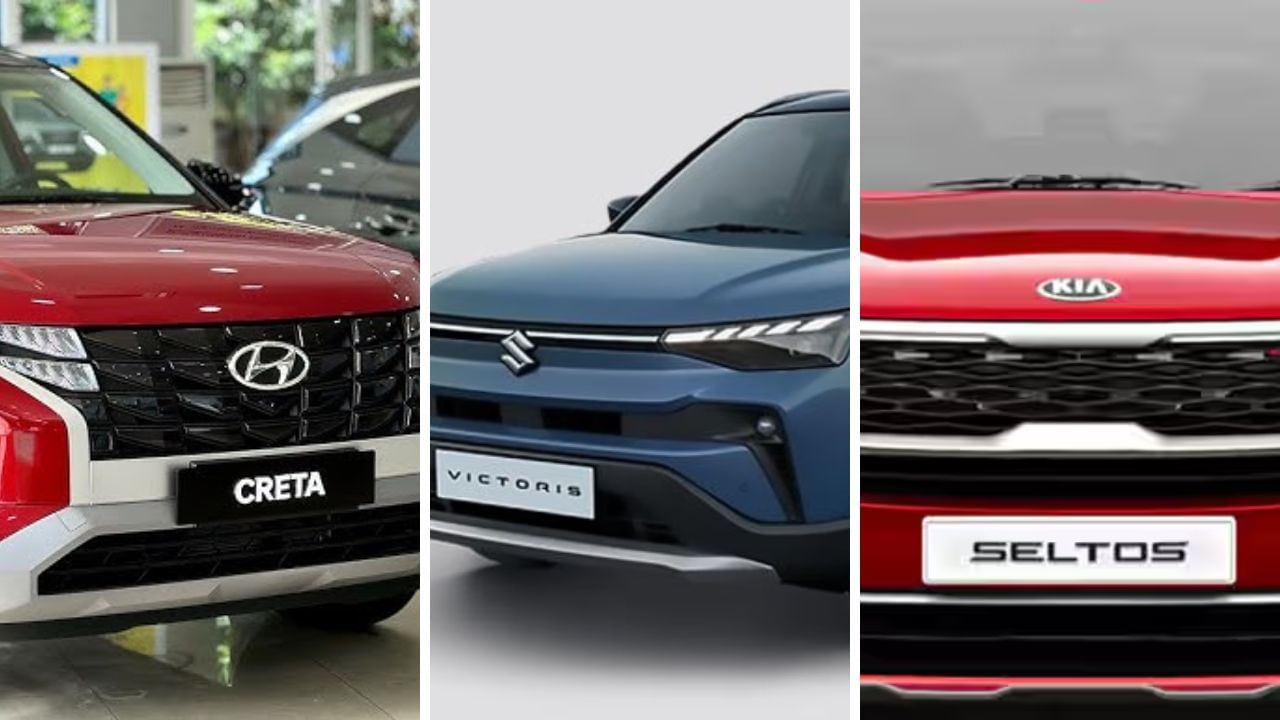
The mid-size SUV segment in India is fiercely contested. Hyundai Creta and Kia Seltos have long been favorites, owing to their design, features, and brand reliability. The Maruti Suzuki Victoris now enters this market, aiming to gain a foothold. In this competitive landscape, price is a key differentiator. Let’s examine how the Victoris fares against its Korean rivals in terms of cost. The base petrol manual variant of the Victoris is priced at approximately ₹10.49 lakh, compared to the Creta’s base model (E 1.5 petrol MT) which starts at roughly ₹11.10 lakh, making the Victoris about ₹60,000 cheaper. For mid-range variants, the Victoris (VXi and ZXi) costs between ₹11.79 lakh and ₹13.57 lakh, while the Creta (EX and S trims) falls between ₹12.5 lakh and ₹15-16 lakh, also positioning the Victoris as the more affordable option. Automatic variants of the Victoris are available from ₹13.35 lakh to ₹17.7 lakh. The Creta’s SX and SX(O) automatic variants reach ₹19-20 lakh. Here too, the Creta is, on average, ₹1.5-2 lakh more expensive. Compared to the Seltos, the Victoris’ base variant is ₹10.49 lakh, while the Seltos’ base HTE (O) 1.5 petrol MT is priced around ₹11.19 lakh. This makes the Seltos approximately ₹70,000 more expensive. The mid-range Victoris (VXi, ZXi and automatic) is available for ₹11.79 lakh – ₹17.7 lakh. Seltos (HTK, HTK+, HTX) ranges from ₹12.5 lakh to ₹18 lakh. The Victoris is generally slightly cheaper here. The top variant of the Victoris (hybrid CVT) is approximately ₹19.99 lakh, while Seltos GTX+, Diesel AT, and X-Line variants are priced above ₹20.5 lakh. Overall, the Victoris is more economical in most variants. The Creta’s base and mid-range segments are more expensive than the Victoris. However, it offers more features. The Seltos provides a stylish and premium package, but its price exceeds that of the Victoris.
Maruti Suzuki Victoris: A Price Analysis Against Hyundai Creta and Kia Seltos
 By The Chhattisgarh2 Mins Read