

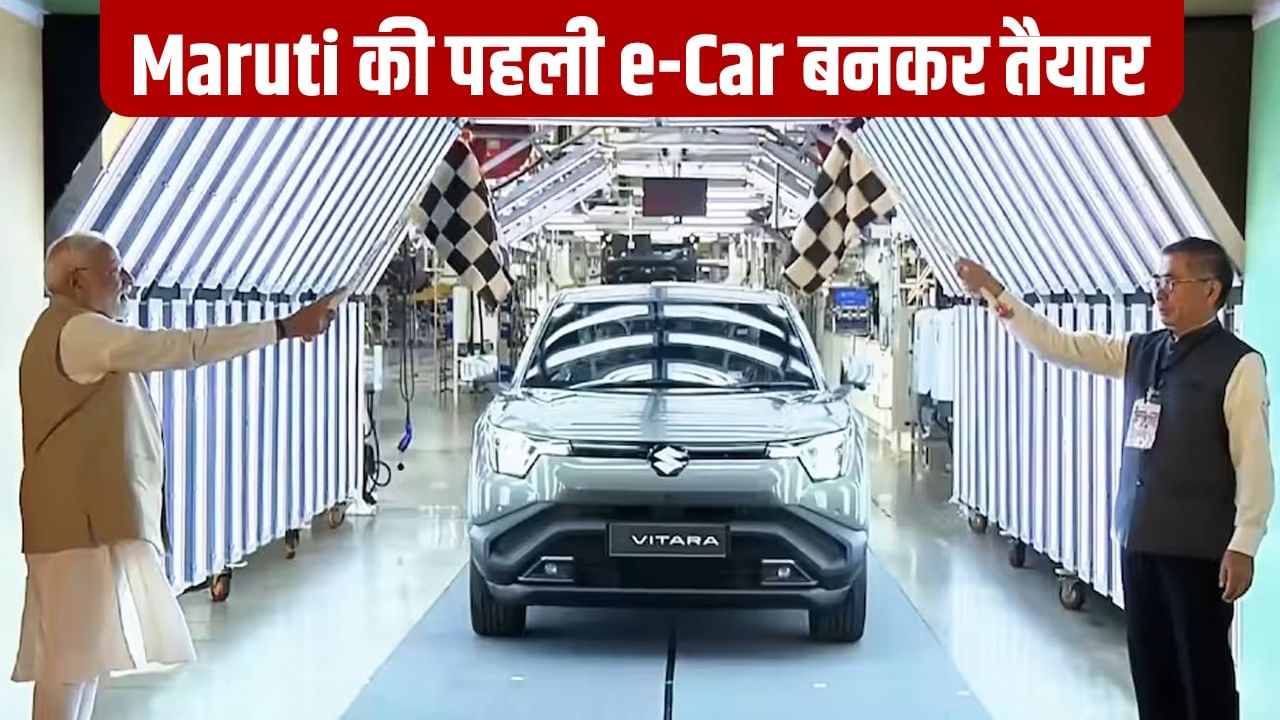
After significant anticipation, Maruti Suzuki’s first all-electric vehicle, the e-VITARA, has been developed. Prime Minister Narendra Modi inaugurated the SUV at Maruti Suzuki’s Gujarat plant, marking its initial production. The official India launch is projected for September 3rd, with exports commencing shortly thereafter to approximately 100 countries. The e-VITARA signifies a pivotal moment as Maruti’s maiden foray into electric vehicles.
Within the Indian EV market, Tata, MG, and Mahindra have already secured substantial market shares. The question arises whether Maruti Suzuki, entering the EV sector later, can effectively compete with these established entities.
India’s electric car market is experiencing rapid expansion. July witnessed sales of 15,423 electric cars, a 93% increase over the previous year. This includes SUVs, sedans, and MPVs, with SUVs dominating sales. Tata Motors currently leads the EV segment, followed by MG Motors, Mahindra, Hyundai, and BYD.
Tata Motors holds the largest EV portfolio in India and dominates sales. Models like the Punch, Nexon, Curve, Tiago, and Tigor, alongside the newly launched Harrier, are prominent. However, competition has led to a decline in Tata’s market share, falling to 38% from 67% last year.
JSW MG Motor India secured second place with 5,061 units sold last month, increasing its market share from 16% to 32%. Their portfolio includes the Windsor, Comet, and ZS EV, alongside recent additions such as the M9 MPV and the Cyberster electric sports car. Mahindra’s electric car sales reached 2,810 units in July, doubling their market share to 17% from 8%, with the BE6 and XEV 9e models bolstering their presence.
With India’s EV segment growing, and monthly sales of 15,000 units, Maruti aims to establish itself in the market. The e-VITARA, an SUV, is poised to compete with Hyundai Creta EV, Windsor EV, and Tata Nexon EV. Given Maruti’s history as a top-selling car manufacturer, consumer trust may translate into success for the e-VITARA.
While the e-VITARA is currently slated for export, it could be launched in India next month, but its on-road presence will follow. Maruti has emphasized a measured approach, focusing on developing the EV ecosystem, including charging infrastructure and service networks. Leveraging their extensive existing network for ICE cars, Maruti plans to optimize their infrastructure for EVs.
Globally, the e-VITARA offers two battery pack options: a 49 kWh unit and a 61.1 kWh unit. The smaller battery provides 142 bhp, 193 Nm of torque, and a range of up to 344 km. The larger battery comes in front-wheel-drive and all-wheel-drive configurations, offering 171 bhp with a range up to 426 km, and 181 bhp with a range of 395 km, respectively. The price of the e-VITARA will be disclosed upon its India launch.