

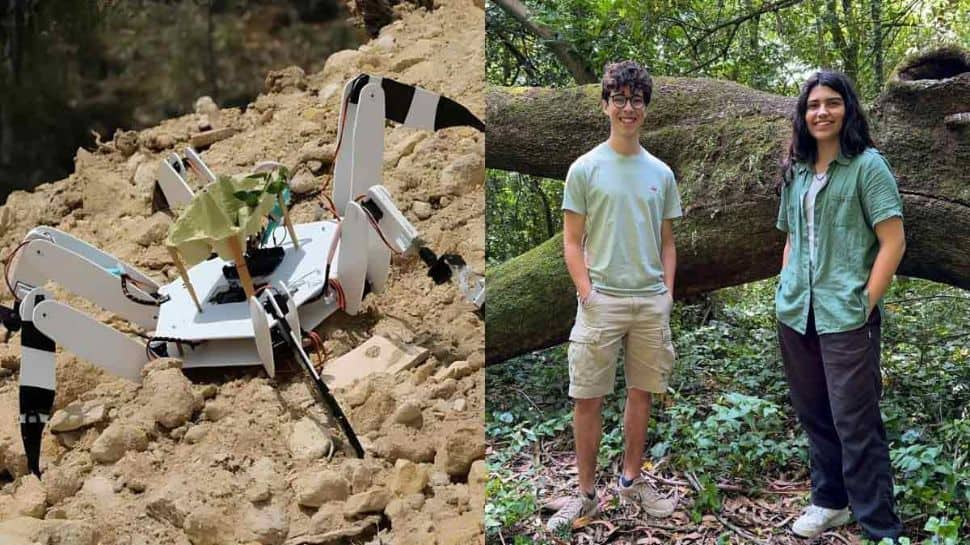
The recurring wildfires near Lisbon, Portugal, deeply impacted Marta Bernardino and Sebastião Mendonça during their school years. These formative experiences inspired them to create a technological solution for regenerating burnt forestland. By age 19, they had developed Trovador, an innovative six-legged robot designed to replant areas too dangerous or inaccessible for humans and conventional machinery.
Trovador, with its spider-like gait, can traverse challenging, unstable terrain, carrying young trees to scorched hillsides. This invention directly addresses the persistent problem of wildfires in Portugal, which have devastated vast tracts of land.
Official data reveals a stark reality: from 1980 to 2023, over 1.2 million acres of Portuguese forest have burned. The year 2017 was particularly devastating, with wildfires accounting for the majority of the 32,000 acres lost. A significant portion of these fires occurs on steep, inaccessible slopes, hindering post-fire recovery efforts.
Bernardino and Mendonça identified the terrain itself as the primary barrier. They noted that steep inclines, which comprise over 60 percent of Portugal’s forest land, make manual planting and the use of heavy machinery impractical. This cycle of fire and difficult regeneration necessitates a new approach.
The Trovador prototype, built with a modest budget and recycled materials, proved remarkably effective. It outperformed human crews in planting speed by 28 percent and achieved an exceptional 90 percent sapling survival rate without additional care. This success paved the way for a more advanced version capable of operating on extreme gradients up to 45 degrees.
“We build all-terrain robots that carry baby trees on their backs and plant them autonomously across difficult terrain,” stated Bernardino. Trovador’s six-legged chassis ensures a light footprint, preventing soil compaction and preserving the soil’s aeration and water-retention properties crucial for young roots. An integrated depth-sensing camera and AI system allow the robot to navigate obstacles and assess soil conditions, including pH and moisture, before planting. The planting process, involving digging, placement, and tamping, is designed for maximum success, with field trials indicating 85-90 percent survival rates.
Unlike drones, which often scatter seeds with low accuracy and survival, Trovador’s precise, single-sapling planting method is far more efficient and resource-conscious. This targeted approach optimizes sapling placement in favorable micro-environments. The robot can plant approximately 200 saplings per hour and transmits vital operational data to the cloud.
Their pioneering work has earned international recognition, including a $10,000 grant from National Geographic and a European sustainability award. Experts have praised the design for its potential in reforestation, while also suggesting further validation of its long-term performance, resilience in dense vegetation, and overall reliability. To ensure affordability and accessibility, the creators intend to offer Trovador as a service rather than a product, enabling organizations to easily implement replanting programs. They aim for Trovador to be actively restoring damaged landscapes by 2026, responding to the urgent need for scalable climate change mitigation.