

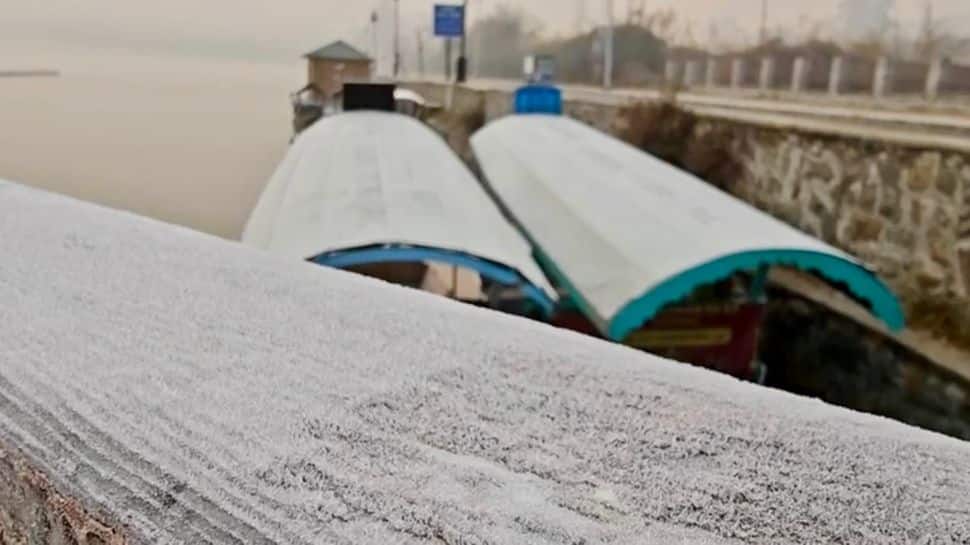
A significant cold wave has descended upon Kashmir, pushing temperatures several degrees below freezing and disrupting normal life. The current spell of extreme cold is largely due to prolonged dry weather and clear nights, which allow for rapid heat dissipation from the ground. In response to the biting chill, the government has announced an early closure of schools for winter vacations, and health advisories are being circulated.
Wednesday night saw an intensified grip of the cold across Jammu & Kashmir and Ladakh, with a sharp decline in temperatures observed in almost every location. All recorded stations within Kashmir remained below the freezing mark. Srinagar recorded a low of -4.4°C, while Shopian was one of the coldest spots at -6.5°C. Pulwama and Baramulla reported -5.8°C, Pampore -5.5°C, and Anantnag -5.7°C.
Srinagar Airport registered -5.2°C, and the popular tourist destination Pahalgam reached -5.0°C. Other areas experienced similar frigid conditions: Budgam (-4.6°C), Bandipora (-4.5°C), Awantipora (-4.0°C), Sonamarg (-4.0°C), Ganderbal (-3.3°C), Qazigund (-4.0°C), and Kokernag (-1.6°C). Gulmarg was slightly warmer at -1.0°C, while Kulgam recorded -2.4°C.
In Ladakh, Leh recorded -8.6°C, Kargil -9.5°C, and Nubra -7.7°C. The lowest temperature in the region was observed at the treacherous Zojila Pass, plummeting to an extreme -16.0°C.
Conversely, the plains of the Jammu region stayed above freezing, with Jammu city at 8.7°C and Katra at 8.5°C. However, higher elevations in Jammu were significantly colder, including Banihal at -1.5°C and Bhaderwah at 0.4°C.
The absence of insulating snowfall and rainfall has contributed to the persistent cold. This dry spell allows the ground to lose heat rapidly, intensifying the freeze. Evidence of the extreme cold includes icicles forming on trees and a thick layer of ice covering roads and partially frozen water bodies in higher elevations.
The IMD anticipates that these dry and cold weather patterns will continue for approximately another week. A brief period of cloudy weather might occur around December 2-3, followed by a potential spell of rain and snow from December 6 to December 10. This precipitation could provide some relief from the prevailing dry conditions. It’s important to note that Kashmir has not yet entered ‘Chillai-Kalan’, the 40-day period of most severe winter cold, which typically begins on December 21.