

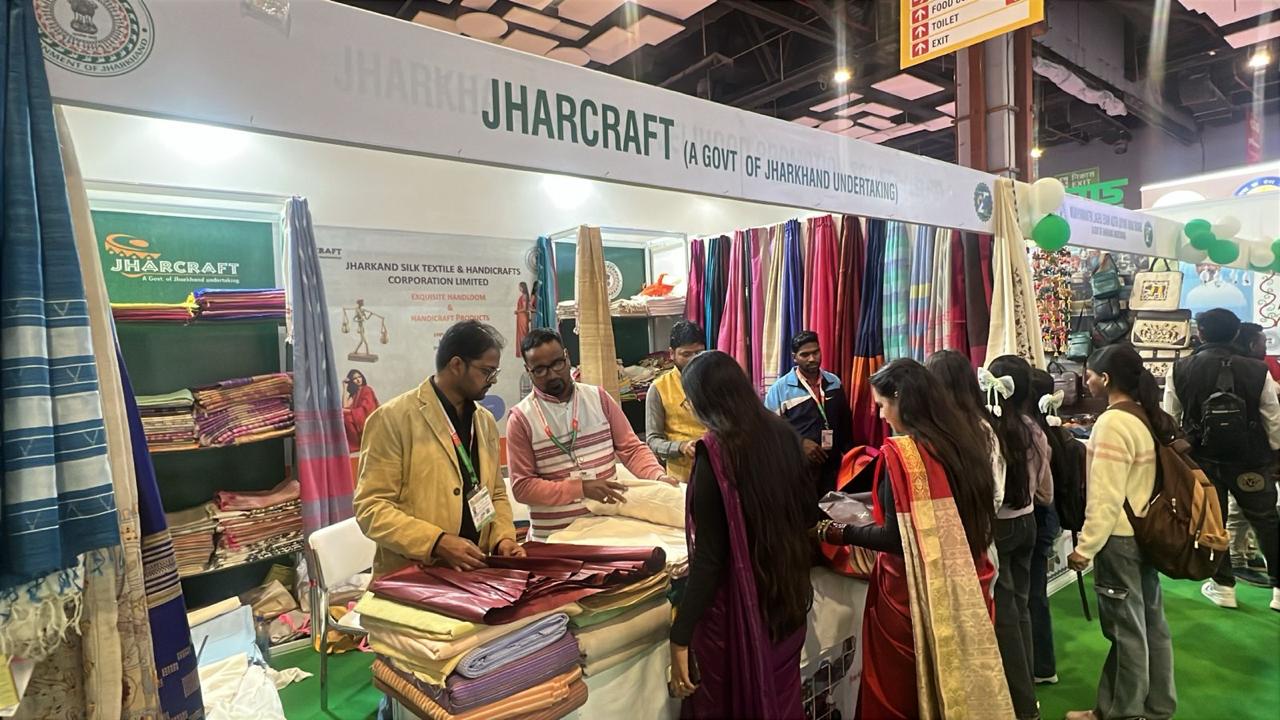
From Tasar to progress: The strength of the state’s national leadership was visible in the Jharkhand Pavilion
New Delhi, 2025: The Jharkhand Pavilion at the India International Trade Fair (IITF) 2025 is particularly in the spotlight this year. The biggest reason for this is Jharkhand’s unique identity in the field of Tasar silk, where Jharkhand alone contributes 70 percent of the country’s total Tasar production. This achievement is not only a testament to the state’s natural resources and skills but also a story of a strong rural economy emerging under women’s leadership.
Jharkhand has established itself as the Tasar capital of the country
Jharkhand’s Tasar industry is rapidly advancing today with a clear vision—to strengthen local livelihoods, increase raw silk production, build a complete ecosystem related to Tasar, and give the state a distinct place on India’s handicraft map. Under this mission, 100 cocoon conservation centers and 40 fully equipped project centers are operational in Jharkhand today. The production of raw silk increased from 90 metric tons in 2001 to 1,363 metric tons in 2024–25, establishing Jharkhand as the Tasar capital of the country. At the heart of this unprecedented success are the women of Jharkhand. Women have active participation in 50–60 percent of Tasar production activities, from cocoon processing to Tasar yarn production and manufacturing of finished products. Notably, yarn production is done entirely by women workers, which has made them economically empowered and a significant pillar of the state’s Tasar economy.
Several schemes are being run by the Industry Department and the Directorate of Silk to further strengthen this growing role of women. With the support of Jharcraft, Jharkhand State Livelihood Promotion Society (JSLPS), and other organizations, training, employment, and market access are being provided to women. Additionally, in Common Facility Centers (CFC) established across the state, 30–60 women are engaging in production, skill development, and training activities simultaneously, moving towards self-employment and entrepreneurship. Sericulture-based training programs for young rearers and farmers are also creating new opportunities.
The main attraction of the pavilion is a live demo of the traditional process of extracting silk yarn from cocoons
The main attraction of the pavilion is a live demo where the traditional process of extracting silk yarn from Tasar cocoons is demonstrated live. Trained women artisans explain each step in detail, from boiling the cocoons to preparing the yarn. Meanwhile, “Tamsum” presents the art of weaving fabric on a loom using the same yarn. This unique demonstration not only showcases the rich heritage of the Tasar industry but also highlights the significant role of women, who have become a strong base for sustainable livelihoods in rural and tribal areas.
Along with this, Jharcraft is effectively presenting its important role in bringing the state’s rural art, craftsmanship, and Tasar-based handicrafts to national recognition in the Jharkhand Pavilion. The exquisite products displayed at IITF 2025 not only bring forth Jharkhand’s rich handicraft tradition but also tell a strong story of the economic empowerment of the artisans.
The Jharkhand Pavilion at IITF 2025 brings to life the glorious journey associated with Tasar production under one roof, where the sheen of Tasar, the hard work of women, and the inspiring saga of rural Jharkhand’s progress are seen moving forward together.