

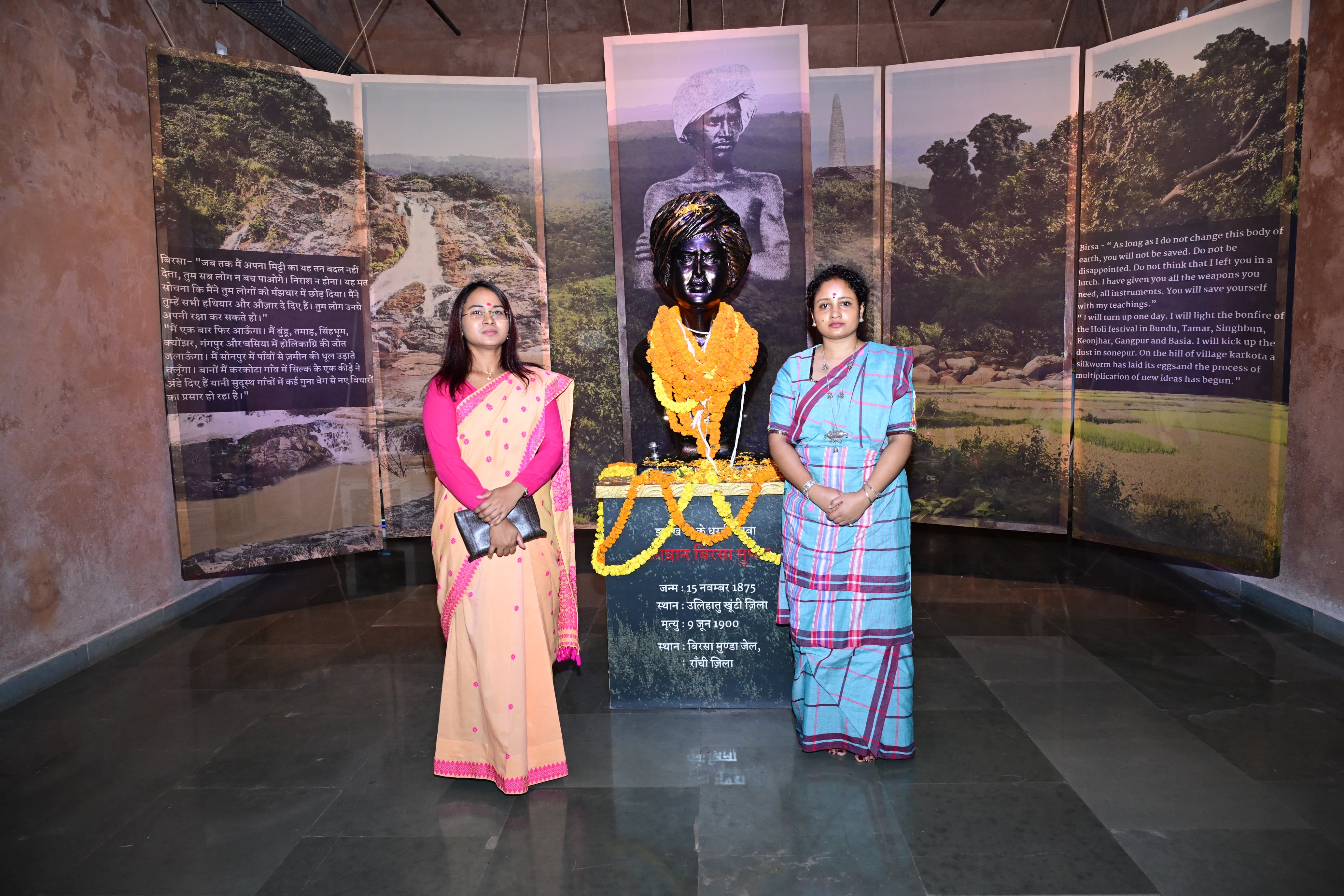
Pure natural honey, lac, and silk products made in the Jharkhand Pavilion are attracting visitors.
New Delhi: At the Jharkhand Pavilion of the ongoing India International Trade Fair in Pragati Maidan, Delhi, people are gaining information and also showing interest in natural honey and silk products at the stall of the Forest, Environment and Climate Change Department. According to Forest Circle Officer Mr. Rajendra Prasad, 31.8% of Jharkhand’s land is covered by forests. The most abundant tree in our forests is the Sal tree. Besides, trees like Gamhar, Sisam, Sagwan, etc., are also found, whose wood is used for commercial and domestic goods. For beautification, we have trees like Gulmohar, Jacaranda, Plumeria, Amaltas. The abundance of bamboo is also a source of income for villagers and businessmen. The Forest, Environment and Climate Change Department works on several projects for forest conservation, among which the Chief Minister Jan Van Yojana is important.
For conservation, the department forms committees with the help of villagers. With their assistance, forest protection is ensured, which in turn keeps our environment balanced. Along with this, these committees also process and sell forest products. This year, products from Raj Mahal are being sold at the Pavilion stall. The honey from our state is natural, and special honey varieties like Litchi, Karanj, Van Tulsi, Wild Honey, etc., are prominent.
Valuable items like organic cashews, honey, and lac are obtained from Jharkhand’s forests. Regarding herbs, Shatavari, Gokhru, Kalmegh, Neem, Anantmool, Arjun, Brahmi, Shankhpushpi, Bakas Vasa, Hadjod, Kanchanar, Bhringraj, etc., fulfill the demand from Jharkhand and other parts of the country. Our department also works extensively for the conservation of wildlife. In Jharkhand state, there is 1 Tiger Reserve, 1 Elephant Reserve, 1 National Park, 11 Wildlife Sanctuaries, 1 Biological Park, 1 Deer Park, 1 Crocodile Breeding Center. In-situ conservation of wildlife has been done in Palamau Betla Tiger Reserve, Singhbhum Dalma Elephant Reserve, Betla National Park, and 11 Wildlife Sanctuaries such as Hazaribagh Wildlife Sanctuary, Koderma Wildlife Sanctuary, Gautam Buddha Wildlife Sanctuary, Palkot Wildlife Sanctuary, Mahuadand Wolf Sanctuary, Palamau Wildlife Sanctuary, Topchanchi Wildlife Sanctuary, Lawalong Wildlife Sanctuary, Mahuadand Wildlife Sanctuary, Udwa Bird Sanctuary, and Dalma Wildlife. Whereas ex-situ conservation of wildlife is carried out at Muta Crocodile Breeding Center Ranchi, Birsa Mrig Vihar Kalamati Ranchi, and Bhagwan Birsa Biological Park Ormanjhi Ranchi. The Forest, Environment and Climate Change Department is sharing all this information at the Jharkhand Pavilion.