

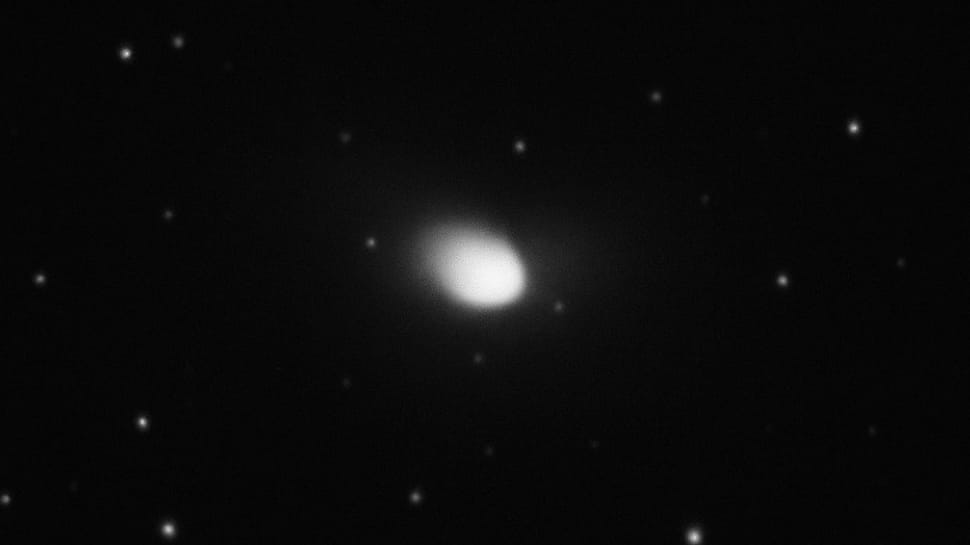
In a remarkable feat of space observation, China’s Tianwen 1 orbiter has successfully photographed the interstellar comet 3I/ATLAS during its recent passage near Mars. The China National Space Administration (CNSA) released these extraordinary images, captured between October 1st and 4th, providing scientists with their first close-up look at this visitor from outside our solar system. This event marks another significant contribution to space science from the Tianwen 1 mission.
Objects originating from interstellar space are exceedingly uncommon, making each confirmed sighting a precious opportunity for scientific discovery. 3I/ATLAS is only the third interstellar visitor detected, following ‘Oumuamua in 2017 and 2I/Borisov in 2019. The comet’s proximity to Mars prompted an international scientific effort, with multiple space agencies aiming to study it. Tianwen 1 played a crucial role, adapting its High-Resolution Imaging Camera (HiRIC) to focus on the distant, fast-moving comet instead of its usual target, the Martian surface.
Tracking 3I/ATLAS required exceptional precision. The comet, estimated to be about 5.6 kilometers in diameter, was hurtling through space at an astonishing speed of nearly 58 kilometers per second. To achieve the images, the Tianwen 1 mission control had to refine tracking protocols and enhance the orbiter’s observational capabilities beyond its standard Martian operations. The resulting data revealed the comet’s solid nucleus and a diffuse coma, a vast envelope of gas and dust extending thousands of kilometers. This success highlights the technical prowess and adaptability of the Tianwen 1 mission.
This observation is more than just a photograph; it’s a critical technical experiment that extends the orbiter’s scientific utility. The insights gained will be instrumental for future deep-space exploration endeavors, including the upcoming Tianwen 2 mission, which is slated to retrieve samples from a near-Earth asteroid. Tianwen 1, launched in July 2020, has a distinguished record, including its successful orbit insertion around Mars in February 2021 and the deployment of the Zhurong rover. The orbiter continues its valuable work, adding this interstellar comet imagery to its list of achievements and furthering China’s ambitious space program.