

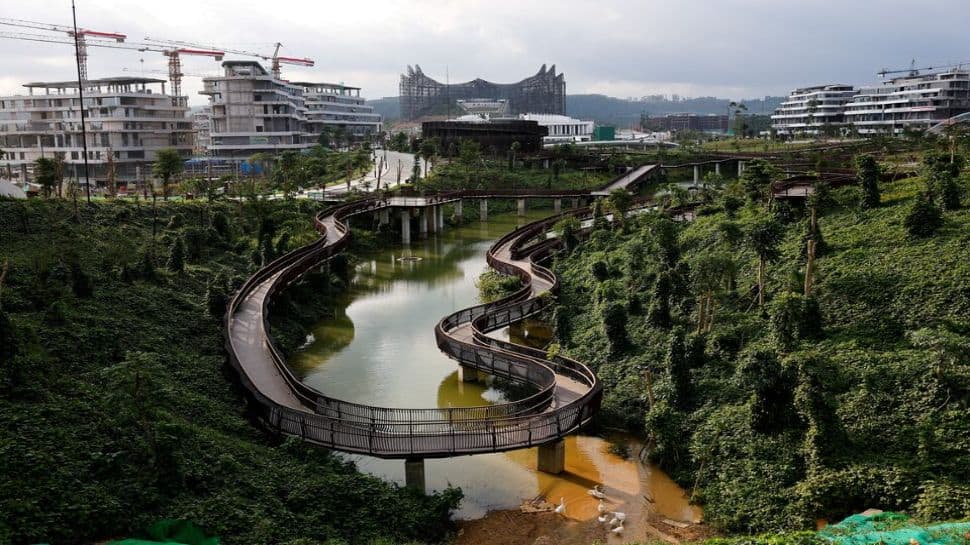
The ambitious undertaking to establish Indonesia’s new capital, Nusantara, in the heart of Borneo’s rainforests, is now confronting serious doubts about its viability. The city, intended to be a modern testament to national advancement, risks becoming an empty expanse, a ‘ghost city.’ This move, initiated by former President Joko Widodo, aimed to relocate the nation’s capital from the congested streets of Jakarta to a more sustainable and spacious environment by the year 2030.
Today, the wide boulevards of Nusantara are eerily quiet, lined with government structures that are still incomplete. Save for a few maintenance workers and curious onlookers, the vibrant urban center envisioned for this new Indonesian era has yet to materialize. The project’s challenges have intensified following the inauguration of President Prabowo Subianto in October. His government has significantly curtailed financial support for Nusantara. Funding for 2025 has been reduced to around 700 million pounds, a stark contrast to the roughly 2 billion pounds allocated in 2024. Future allocations are even more precarious, with only 300 million pounds approved for the following year, representing just a third of the amount requested. The anticipated influx of private investment has also failed to meet expectations, falling short by over 1 billion pounds.
Adding to the prevailing disquiet, President Prabowo has not made any visits to Nusantara since assuming his presidential duties. While he officially declared Nusantara the “political capital” in May, this designation was only formally announced four months later. The administrative leadership of the project has also been shaken, with the agency’s head and deputy head both resigning in 2024, further amplifying concerns about the capital’s trajectory.
Currently, Nusantara accommodates a small population of about 2,000 government officials and 8,000 construction laborers, a significant shortfall from the projected 1.2 million residents by 2030. Despite possessing essential infrastructure like apartment blocks, ministry offices, roads, healthcare facilities, and an airport, much of the city remains in a state of ongoing development.
Academics have voiced apprehension, likening the current state of Nusantara to a “ghost city.” Constitutional law expert Hardiansyah Hamzah observes that the “political capital” title carries little legal weight and signals that the project is not a priority for the current administration. The dream of a futuristic capital for the world’s largest Muslim nation is now shadowed by uncertainty, poised precariously between grand ambition and potential abandonment.