

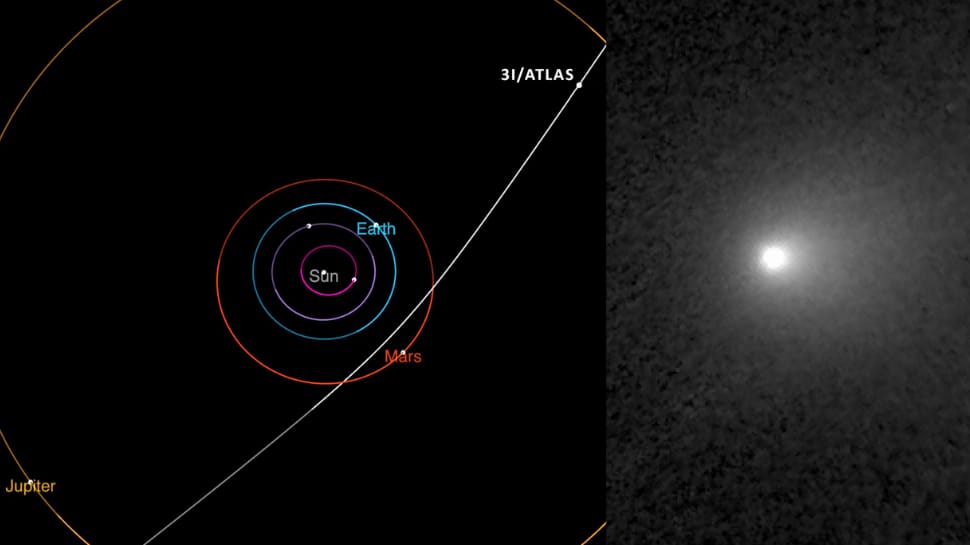
Interstellar comet 3I/ATLAS, detected on July 1, 2025, has become the third known visitor from beyond our solar system. While NASA assures it poses no threat, its highly unusual characteristics have captured the attention of scientists, sparking a debate that includes the possibility of alien technology. Harvard astrophysicist Avi Loeb is among those who believe the comet’s peculiar traits might point to an artificial origin.
One significant anomaly is the comet’s chemical makeup. It’s observed to release about four grams of nickel per second without any trace of iron, a pairing that is chemically rare in natural formations. This unusual elemental signature has led some researchers to question if the comet’s components were deliberately manufactured.
Adding to the enigma, scientists detected nickel tetracarbonyl, a compound commonly used in industrial metal refining on Earth. Loeb suggests this finding strongly implies the presence of engineered materials, bolstering the case for alien technology.
The comet’s anti-solar tail, observed early on, was a particularly baffling phenomenon, pointing towards the Sun. This characteristic is virtually unseen in natural comets. The subsequent shift of the tail to point away from the Sun has led Loeb to hypothesize that this could indicate controlled movement or intentional maneuvering, possibly by an intelligent entity.
Furthermore, 3I/ATLAS follows a hyperbolic trajectory, meaning it is not bound by the Sun’s gravity. This rapid, unbound path through interstellar space is uncommon for objects originating from typical stellar systems and aligns with characteristics expected of artificial probes.
Loeb’s team also noted the apparent absence of rocky material on 3I/ATLAS’s surface. For an object of its size navigating space, this lack of typical geological features and its smooth, reflective appearance could suggest it is constructed from refined metals, similar to man-made spacecraft.
Its dimensions, approximately 12 miles wide, coupled with its extraordinary velocity of over 130,000 mph, make it one of the largest and fastest interstellar objects ever encountered. These impressive metrics raise questions about its propulsion and design for deep-space travel.
Considering its composition, emissions, and behavior, 3I/ATLAS bears a remarkable resemblance to industrial materials used in terrestrial metal processing. Loeb finds this correlation too striking to dismiss, proposing it as strong evidence for an engineered object of extraterrestrial origin.
As comet 3I/ATLAS reaches its closest approach to the Sun between October 29-30, enhanced observations from multiple spacecraft are anticipated. These crucial data could provide definitive answers about its origins and potentially rewrite our understanding of life beyond Earth.