

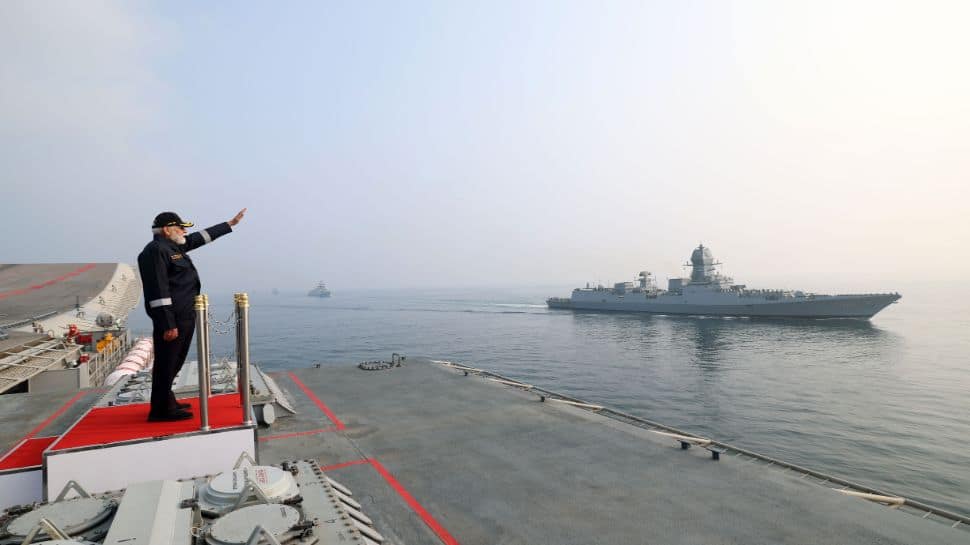
During a recent visit to the newly commissioned INS Vikrant, India’s first indigenous aircraft carrier, Prime Minister Narendra Modi stood on a deck concealing a potent secret weapon: the Barak-8 missile system. This advanced surface-to-air missile, housed within the ship’s vertical launch system (VLS), is a cornerstone of Vikrant’s formidable defensive capabilities, designed to project power and ensure maritime security.
INS Vikrant is no ordinary vessel; it’s a floating bastion of Indian defense innovation. The core of its protective shield is the Barak-8 missile, strategically positioned beneath the flight deck. The carrier is equipped with 32 launch cells for these missiles, each capable of engaging and destroying airborne threats – including aircraft, drones, and incoming missiles – within a 100-kilometer radius. This integrated air defense system makes Vikrant exceptionally self-sufficient, a significant advantage as most aircraft carriers depend on external support for such defense.
Named ‘Barak,’ meaning ‘lightning’ in Hebrew, the missile lives up to its moniker with incredible speed and precision. A product of collaborative development between India and Israel, the Barak-8 operates with remarkable autonomy. It features its own radar for target acquisition and tracking, initiating a lock-on and engagement sequence independently. Launching vertically from its cell at over 2,500 kilometers per hour, the 4.5-meter-long, 275-kilogram missile, armed with a 60-kilogram warhead, can intercept targets at altitudes up to 20 kilometers. Its advanced guidance ensures accuracy even in challenging weather conditions like fog or rain, making it a highly reliable interceptor.
Beyond its impressive armament, INS Vikrant itself is a testament to India’s engineering prowess. This 40,000-ton warship, with a top speed of 30 knots, can host a complement of 26 MiG-29K fighter jets and eight helicopters. However, its defensive independence, particularly its integrated Barak-8 system, is what truly sets it apart. This ‘mini-destroyer’ capability reduces the need for a large screen of escort vessels, enhancing operational flexibility. The deployment of the Barak-8 also signifies India’s strategic push towards self-reliance in defense manufacturing and strengthens its long-standing defense partnership with Israel. As Vikrant navigates the Indian Ocean, it projects India’s growing maritime strength and its unwavering commitment to national security.