

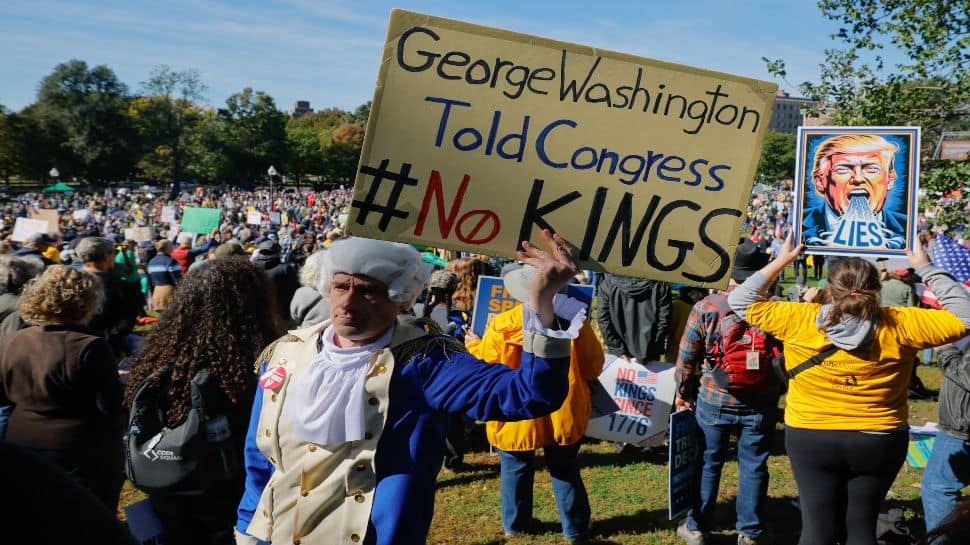
A powerful wave of “No Kings” demonstrations swept the nation this past weekend, mobilizing millions of Americans to voice their opposition to President Donald Trump’s increasingly regal public image. The President’s reaction to these widespread protests was notably dismissive and tinged with mockery. His and Vice President JD Vance’s social media accounts featured imagery that depicted Trump as a monarch, including a striking visual of him piloting a fighter jet emblazoned with “KING TRUMP” over protesting citizens, and another showing prominent Democratic figures kneeling before him. These posts quickly went viral, emphasizing the administration’s focus on asserting authority and control while also highlighting the growing influence of carefully crafted public perception.
Supporters of these posts often dismissed criticisms as overly serious or humorless, characterizing the imagery as pure MAGA satire. Nevertheless, the visuals served as a potent, albeit subtle, message to many, projecting an image of Trump as an untouchable and supremely powerful figure. This narrative appeals strongly to voters who gravitate towards decisive, strongman leadership. The President’s online theatrics were perceived by many as deeply disrespectful to tens of millions of Americans and a direct challenge to the principles of democratic free speech. While political leaders have historically shown some level of contempt for dissenters, the unprecedented scale and brazen nature of Trump’s displays have set a concerning new benchmark.
Analysts suggest that recent liberal policy shifts may have alienated a portion of the conservative voter base, with these protests reflecting a broader societal unease. Critics argue that the president’s posts are not isolated incidents but rather part of a deliberate strategy to reinforce his authority and marginalize opposition, raising critical questions about constitutional boundaries and effective governance. The situation intensified as the nation approached a potential government shutdown. Trump characterized the mass demonstrations as a “joke,” claiming the protesters were unrepresentative of the country’s actual population and labeling participants as “whacked out.”
Observers, however, consistently reported the protests as peaceful and broadly supported, comprising a diverse mix of activists and moderate citizens. Many participants used creative satire and costumes to articulate their worries about the administration’s policy direction. Beyond social media, Trump’s actions included commuting the sentence of former Representative George Santos, who had pleaded guilty to fraud. This act of clemency was seen by many as politically charged, especially given previous demands from Trump for legal action against political adversaries. This raises grave concerns about the potential weaponization of legal and executive powers for personal or political advantage, potentially undermining faith in an impartial justice system. Santos himself commented on the long history of controversial presidential pardons, while his former colleagues emphasized the seriousness of his admitted crimes.
In foreign policy, Trump authorized unilateral military actions, including a strike on a suspected drug-trafficking boat in the Caribbean. The administration designated the traffickers as terrorists, asserting the unilateral authority to act without due process and bypassing Congress’s constitutional war powers. This move prompted dire warnings from critics about the potential erosion of the rule of law and the creation of dangerous international precedents. Prominent Republican voices reiterated that declarations of war constitutionally require legislative approval.
Further escalating tensions, Trump hinted at potential military intervention in Venezuela, issuing a stark warning to foreign leaders about direct U.S. action if drug production issues were not resolutely addressed. Such actions, according to observers, strain democratic norms and rely heavily on executive fiat without adequate transparency or oversight. The Defense Department also imposed strict press regulations and curtailed media access, fueling anxieties about diminished government accountability.
These combined domestic and international actions point towards a concerning concentration of power and an increasingly autocratic style of leadership. The “No Kings” protests, drawing millions across all fifty states in over 2,700 distinct events, signaled a significant public mobilization against authoritarian tendencies. Organizers estimated participation at seven million individuals, a considerable fraction of the last presidential electorate. The movement unified progressive activists and moderate citizens united by civic concerns. Demonstrators skillfully employed humor, costumes, and satire to counter the administration’s rhetoric, underscoring their commitment to peaceful dissent and democratic principles. The fear of democracy being incrementally dismantled was a recurring theme among retired government workers and participants, with some traveling to the capital specifically to protest this perceived erosion. The White House’s dismissive response to media inquiries amplified the disconnect between the administration and the concerns of a vast segment of the population.