

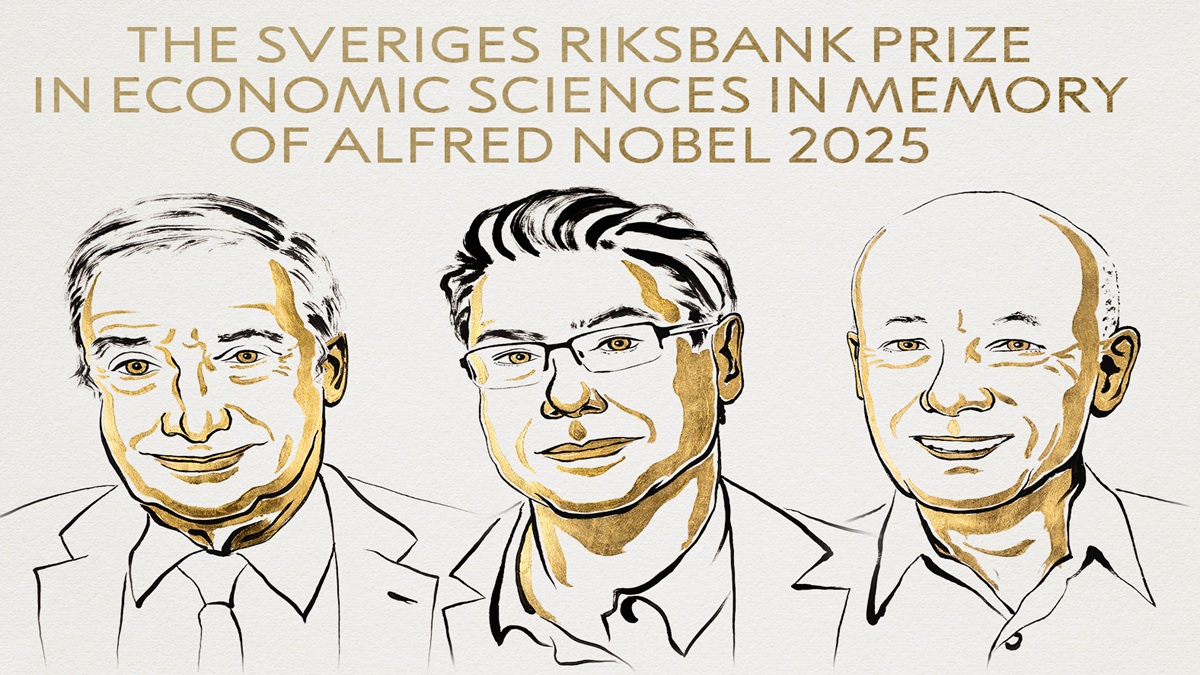
This year’s Nobel Memorial Prize in Economic Sciences celebrates the contributions of Philippe Aghion, Peter Howitt, and Joel Mokyr to understanding how innovation fuels economic expansion. The award is split, with Mokyr receiving one half for identifying the foundational elements required for continuous growth through technological progress. The other half is jointly awarded to Aghion and Howitt for their seminal theory on achieving sustained economic growth via “creative destruction.”
The Nobel committee commended Mokyr for demonstrating that enduring innovation necessitates not only practical know-how but also a robust scientific explanation for why innovations succeed. Mokyr is a professor at Northwestern University. Aghion, associated with the College de France and the London School of Economics, and Howitt of Brown University, formulated a significant mathematical model in 1992. This model captures the essence of creative destruction, where new, superior offerings challenge and eventually replace existing market products.
According to the committee’s chair, the laureates’ work stresses that economic prosperity is not guaranteed and depends on maintaining the mechanisms that enable creative destruction to prevent societal decline into stagnation. The previous year’s prize focused on factors contributing to national wealth and poverty, linking prosperity to the openness and freedom of societies.