

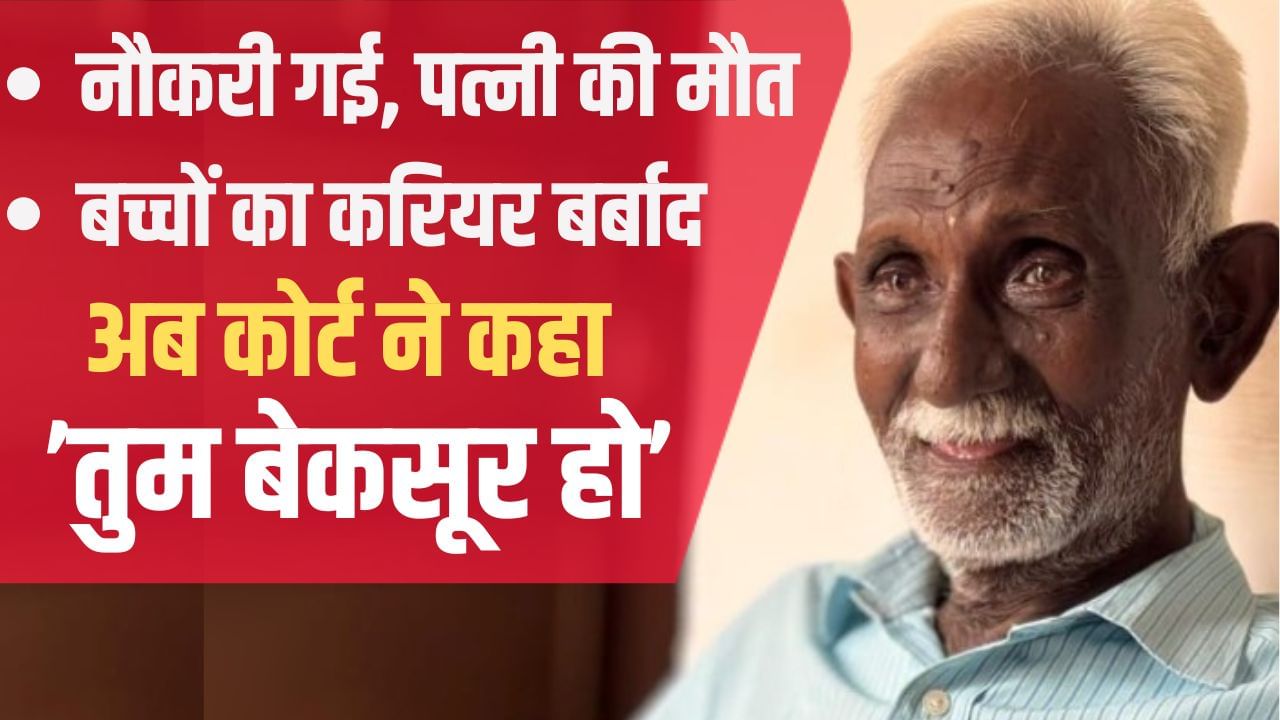
A false accusation of taking a ₹100 bribe in 1986 led to a complete upheaval in the life of 83-year-old Jageshwar Prasad Avadhia, a resident of Raipur, Chhattisgarh. The accusation cost him his job, family, and reputation. After nearly four decades, the High Court has acquitted him. While the court has declared him innocent, the long delay in the judicial process has caused profound and irreversible damage to his life. He is now seeking his pending pension and financial aid from the government.
The incident occurred in 1986 when Avadhia was working as a bill assistant at the Madhya Pradesh State Road Transport Corporation (MPSRTC) office in Raipur. He was pressured by an employee, Ashok Kumar Verma, to approve his bill. Avadhia refused, citing company rules. The next day, Verma attempted to bribe him with ₹20, which Avadhia returned.
On October 24, 1986, Verma forcibly placed ₹100 (two ₹50 notes) in his pocket. At that moment, a vigilance team arrived and arrested Avadhia. He has always maintained that this was a set-up. His hands were washed with chemicals at the time of the arrest, and the marked notes were presented as evidence. Despite this, Avadhia insisted on his innocence.
The impact of the accusation on Avadhia’s life was devastating. He was suspended from 1988 to 1994, and later transferred to Rewa. His salary was cut in half, and he received no promotions or pay increases. His family of four children suffered financially. He struggled to make ends meet on a salary of ₹2,500, unable to afford his children’s school fees, which led to interruptions in their education.
His wife, constantly stressed, passed away. His son, Neeraj Avadhia, who was 12 at the time, recalls being ostracized by society. Neighbors distanced themselves, and his schoolmates avoided him. He was often expelled from school due to unpaid fees. Despite earning a Master’s degree privately, Neeraj could not marry due to financial constraints. Now, at 50, he faces health issues and relies on government rations.
After retirement, Avadhia did not receive a pension. He worked as a watchman and took on other small jobs to survive. His reputation was tarnished, and he was seen as a corrupt official.
In 2004, a trial court found Avadhia guilty under the Prevention of Corruption Act, sentencing him to a year in prison and a fine of ₹1,000. He appealed to the High Court. The High Court, after years of deliberation, found the prosecution’s evidence insufficient, citing that the witnesses, documents, and circumstances presented did not prove bribery. The court overturned the trial court’s decision. After a 39-year ordeal, Avadhia was declared innocent.
Today, Avadhia lives in his 90-year-old ancestral home in Avadhia Para, Raipur. He reflects on the justice he received, questioning the cost of the suffering he and his family endured. He hopes to receive his pension and back pay from his suspension. His son Neeraj feels vindicated by his father’s exoneration, yet acknowledges the irreversible loss of their childhood and youth. They appeal to the government for compensation.
The case emphasizes the critical issue of delays in legal proceedings. Experts emphasize the importance of compensation and timely justice for victims in cases like this. Avadhia’s story underscores the potential for a false accusation to ruin a person’s entire life.