

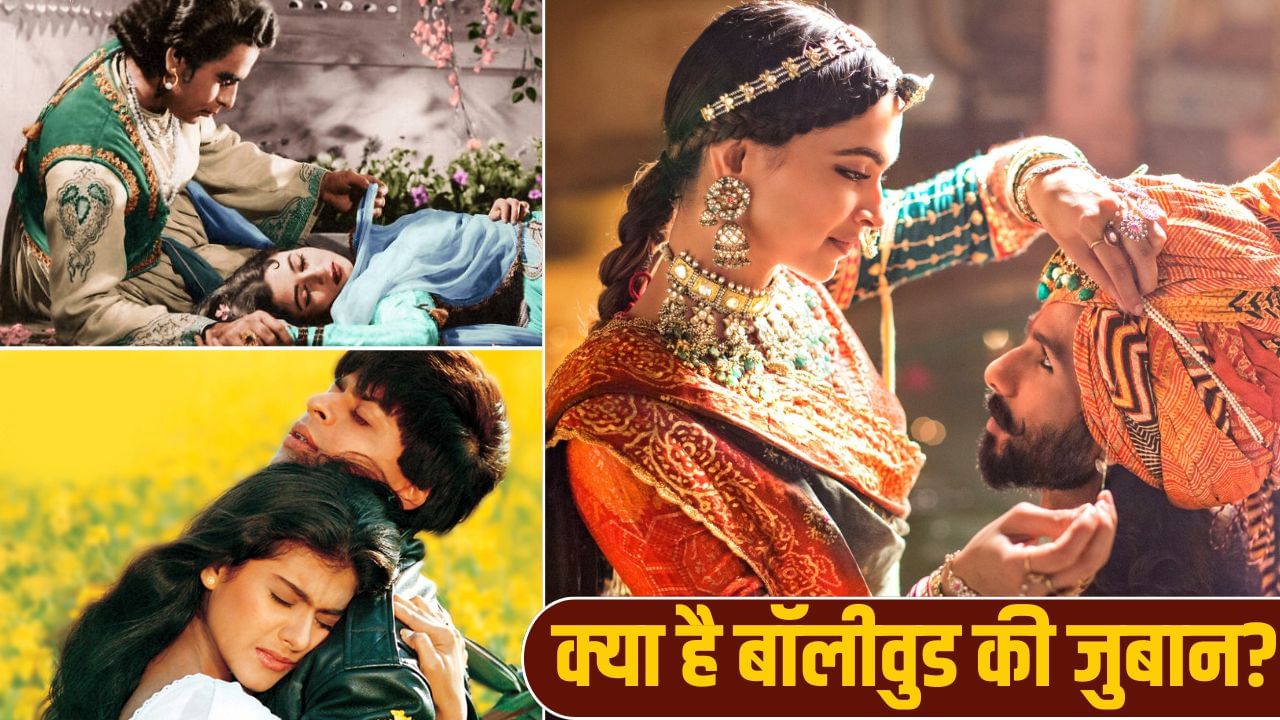
Hindi Diwas is observed annually on September 14th. When the subject turns to Hindi cinema, what immediately springs to mind? Most people likely use the term ‘Bollywood’ instead, and this is not entirely incorrect. Bollywood is widely recognized as synonymous with Hindi cinema, a term derived from a blend of ‘Bombay’ and ‘Hollywood’. However, is Bollywood exclusively Hindi cinema? The response may vary, yet Bollywood extends beyond Hindi, incorporating influences from a multitude of languages and diverse cultural elements.
Hindi films have consistently captivated audiences for numerous years. The box office sees substantial financial investments, often yielding successful outcomes. Similar to the adaptation of an actor’s character within a film, the adoption of local culture and language is essential, a practice that has been consistent and is likely to persist. Let’s delve deeper.
Bollywood: Hindi Cinema, But How?
“Ze-Haal-e-Miskin Makun B-Ranjish, B-Haal-e-Hijraan Bechaara Dil Hai”…This lyric from the 1985 film ‘Ghulam’, from the song ‘Jihaal-e-Miskin’, was penned by Amir Khusro in the 13th-14th centuries. Later, Gulzar drew inspiration from it. This song, a product of the 1980s, carries profound meaning. It represents a fusion of Persian and Hindi, highlighting the significant contribution of Urdu in Hindi cinema. During the 1940s-50s, many film songs were written in Urdu, reflecting its literary and cultural prominence. Thus, Hindi cinema would be incomplete without these languages. The Urdu poetry of Sahir Ludhianvi and Kaifi Azmi further popularized Urdu in Hindi cinema.
2. Punjabi: Given the mention of Urdu, the contribution of Punjabi cannot be ignored. Beyond Punjabi songs, Punjabi culture and language have significantly impacted Bollywood. Films frequently incorporate Punjabi art into narratives and music. Consider the film ‘Dilwale Dulhania Le Jayenge’, which portrayed Punjabi culture.
3. Bengali: What is the source of Bollywood’s storytelling style and depth? The answer lies in Bengali cinema and literature. Filmmakers like Satyajit Ray have made a global impact on Indian cinema. Furthermore, Bengali songs have been frequently adapted as inspiration in Bollywood.
4. Marathi: Situated in Mumbai, Bollywood reflects the influence of the Marathi language and culture. Marathi actors and writers are actively involved in filmmaking. Numerous Marathi films have been remade in Hindi, although the language and culture remain distinct, as demonstrated by films like ‘Dhadak’.
5. English: As ‘new Bollywood’ evolves, the presence of English becomes more apparent. Films showcase Hinglish (Hindi and English) songs, exemplified by titles like ‘Zindagi Na Milegi Dobara’ and ‘Yeh Jawaani Hai Deewani’. Additionally, the Hollywood approach to storytelling has influenced Bollywood.
South Indian cinema has made a substantial contribution to Hindi cinema. The influence of Tamil, Telugu, Malayalam, and Kannada cinema is evident in Bollywood. Many South Indian films are remade in Hindi each year, while others are dubbed. Examples include ‘Drishyam,’ ‘Baahubali (Hindi dub),’ and ‘Kabali.’ Furthermore, folk languages like Bhojpuri, Rajasthani, and Avadhi are featured in songs, with their stories also adapted for the big screen. Consequently, the use of languages beyond Hindi in Bollywood films is commonplace.
Numerous films showcase diverse cultures, dialects, and languages. Hindi cinema is enriched by these contributions. The narratives resonated with audiences, who connected with the local languages and cultures. Whether it’s Bhojpuri songs accompanying Punjabi dances or the popularity of Punjabi music, Bollywood, or Hindi cinema, thrives on this diversity.
Reflections on Bollywood’s Evolution
Chaitanya Padukone, a prominent journalist who closely observes the changes in Bollywood, believes that Bollywood’s language is not solely Hindi but Hindustani. Most films present a beautiful blend of Hindi and Urdu. Many commonly used Hindi film terms, such as ‘Ishq,’ ‘Mohabbat,’ ‘Junoon,’ ‘Fitoor,’ and ‘Zubaan,’ have their origins in Urdu. These words add depth to stories and intensify romantic scenes.
He further notes that Punjabi has also established its unique presence in Bollywood. Punjabi words feature in numerous popular songs and dialogues. Songs like ‘Laung Da Lashkara,’ ‘Amber Sariya,’ and ‘Aaj Teriyan Saiyaan Ne’ serve as evidence of this.