

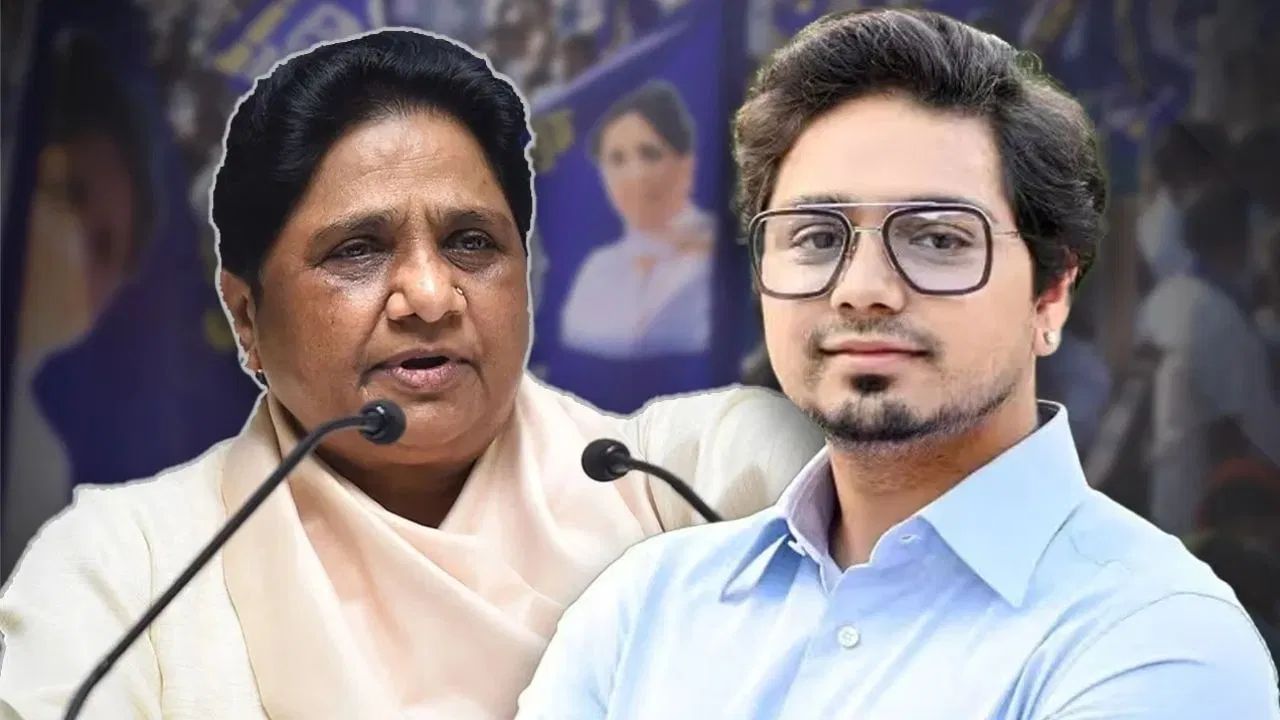
In a significant move, Bahujan Samaj Party (BSP) President Mayawati has restructured the party hierarchy, appointing Akash Anand, her nephew, to the newly established role of National Coordinator. This position places him as the second most powerful figure within the party, trailing only Mayawati. This strategic decision is viewed as a key component of Mayawati’s plan to fortify the BSP in preparation for the 2027 Uttar Pradesh Assembly elections and to bolster the party’s presence in other states. In addition to this appointment, Mayawati has also designated six National Coordinators and new state presidents across various regions, with the aim of injecting fresh direction and vigor into the organization.
Akash Anand, formerly a National Coordinator, will now assume the responsibility of reviewing the operations of all party sectors, including central and state coordinators, and state presidents in his capacity as National Coordinator. He will directly report to Mayawati, thereby solidifying his influence within the organization. This specific role has been created exclusively for Akash, representing a novel structure within the BSP. This demonstrates Mayawati’s intent to groom Akash for a future leadership role.
To enhance organizational efficiency, Mayawati has increased the number of National Coordinators from four to six. These coordinators will operate under the leadership of Akash Anand and report to him. The new National Coordinators include Ramji Gautam (overseeing Delhi, Madhya Pradesh, Chhattisgarh, and Bihar), Rajaram (with Mohit Anand as his assistant), Randhir Singh Beniwal, Lalji Medhankar, Atar Singh Rao (with Suresh Arya as his assistant), and Dharamveer Singh Ashok (with Dayachand as his assistant). These coordinators will divide the nation into three zones to manage the party’s activities. This revised framework represents a crucial step toward enabling the BSP to become more active and effective on a national scale.
Mayawati has also appointed new state presidents in multiple states, including Uttar Pradesh, to strengthen the party’s grassroots connections. Vishwanath Pal has once again been entrusted with the role of state president in Uttar Pradesh. The new state presidents in other states are: Rajesh Tanwar (Delhi), Ramakant Pippal (Madhya Pradesh), Shyam Tandon (Chhattisgarh), Shankar Mahato (Bihar), Dr. Sunil Dongre (Maharashtra), M. Krishna Murthy (Karnataka), P. Anand (Tamil Nadu), Joy R. Thomas (Kerala), Krishan Jamarapur (Haryana), Avatar Singh Karipuri (Punjab), Prem Barupal (Rajasthan), Shiv Pujan Mehta (Jharkhand), Manoj Hawaldar (West Bengal), Saroj Kumar Nayak (Odisha), Bandela Gautam (Andhra Pradesh), Ibram Shekhar (Telangana), Bhagubhai Parmar (Gujarat), Vikram Singh Nayar (Himachal Pradesh), Darshan Rana (Jammu and Kashmir), Brijpal (Chandigarh), and Amarjeet Singh (Uttarakhand). These appointments signal the BSP’s commitment to reinforcing its presence in states where its influence has been relatively weak.
Akash Anand, the son of Mayawati’s younger brother, Anand Kumar, holds an MBA from the University of Plymouth, London. He initiated his political journey in 2016 with a rally in Saharanpur. He was appointed National Coordinator in 2019, and Mayawati named him her successor in December 2023. However, due to some controversial statements and perceived lack of maturity during the 2024 Lok Sabha elections, Mayawati removed him from the roles of National Coordinator and successor. In June 2024, Mayawati reinstated Akash as National Coordinator and successor, but in March 2025, he was again removed, reportedly due to the influence and controversies linked to his father-in-law, Ashok Siddharth.
The return of Akash Anand in May 2025 and his promotion to National Coordinator have rekindled enthusiasm among party workers. This reshuffle by Mayawati is designed with the 2027 Uttar Pradesh Assembly elections and the forthcoming elections in states like Bihar in mind. The BSP’s performance in the 2024 Lok Sabha elections was disappointing, as the party failed to secure a single seat in Uttar Pradesh, and its vote share declined from 19.4% to 9.3%. This setback prompted Mayawati to undertake significant organizational changes. Mayawati has opted to contest the elections independently in Bihar, reflecting the party’s autonomous strategic approach. She has instructed party workers to address the concerns of Dalits, minorities, and backward classes, and to disseminate the philosophies of Dr. B.R. Ambedkar among the public.
Akash Anand’s new role and the introduction of young leadership represent a pivotal step in this direction. This organizational restructuring by Mayawati is a part of the strategy to revitalize the BSP and enhance its performance in the 2027 elections. The appointment of Akash Anand as National Coordinator, along with the appointment of new coordinators and state presidents, will be crucial in evaluating how Akash Anand fulfills his new responsibilities and whether, under Mayawati’s leadership, he can rejuvenate the party’s historical strength. The BSP’s revised structure and youthful leadership could play a significant role in shaping the party’s future direction.