

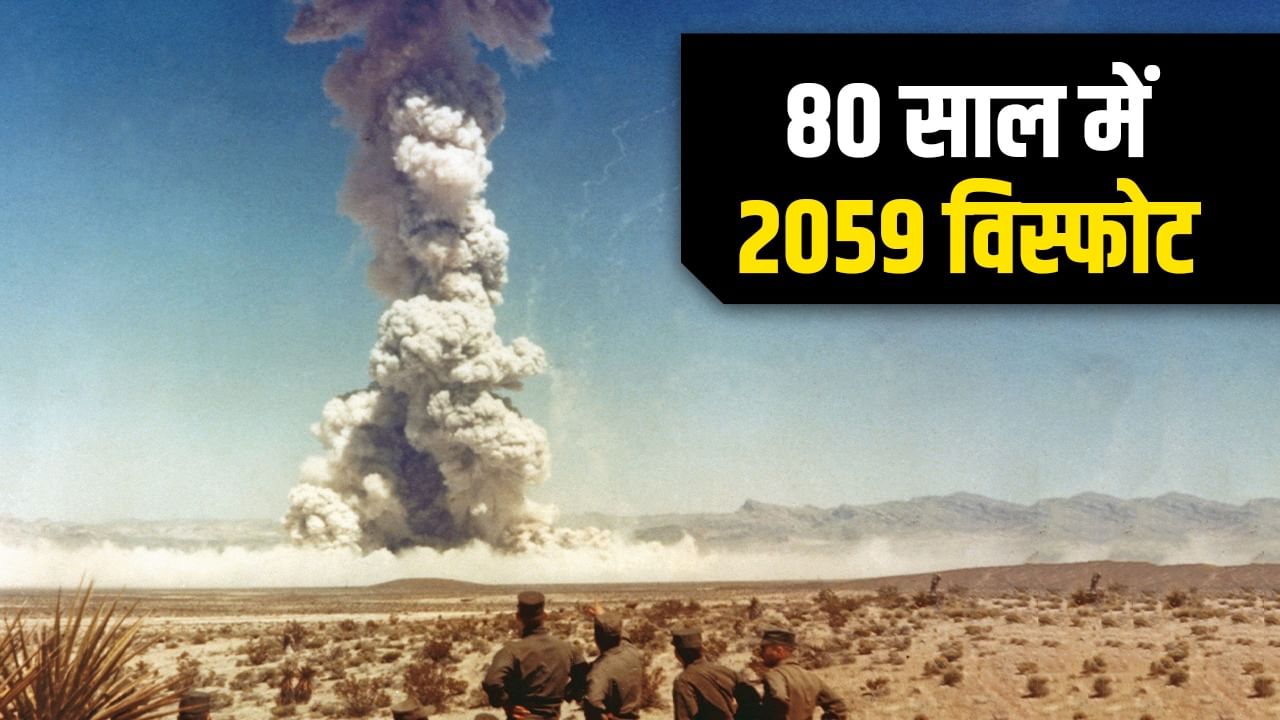
The impact of a nuclear bomb is catastrophic, as demonstrated by the 1945 attacks on Hiroshima and Nagasaki, which resulted in hundreds of thousands of casualties and long-term suffering. Since then, the world has witnessed 2059 nuclear explosions over the past 80 years.
The United States holds the record for the most nuclear explosions, followed by Kazakhstan and France. India has conducted nuclear tests on three occasions, while neighboring Pakistan has done so twice.
These tests were driven by a global arms race and the desire to develop and test nuclear weaponry. The United States conducted a staggering 1030 explosions between 1945 and 1996. Today, the US maintains a stockpile of approximately 3900 nuclear weapons.
Russia, too, engaged in extensive nuclear testing, primarily in Kazakhstan. France, China, and the United Kingdom also contributed to the global count, with North Korea being the most recent country to conduct nuclear tests.
Nuclear weapon stockpiles vary significantly. China possesses roughly 600 weapons, India around 180, Pakistan 150, and North Korea approximately 50.
Nuclear testing sites were diverse. The US conducted tests in Nevada, the Marshall Islands, and the Pacific Ocean. Russia utilized Kazakhstan and the Arctic Novaya Zemlya archipelago. The UK tested in Australia and the Kiritimati archipelago, France in Algeria and French Polynesia, and China in Lop Nur.
India tested in Pokhran, while Pakistan conducted tests in Balochistan. North Korea tested on an island near China.
The long-term consequences of these tests are becoming increasingly apparent. The majority of tests were conducted in environments such as sand or water. In Kazakhstan, millions of people are seeking compensation due to the ongoing health impacts of the tests.
The US relocated residents of the Marshall Islands, but 27,000 still suffer from the effects. France has offered apologies to Algeria. The impacts of these explosions on climate change are also under investigation, with scientists studying their contribution to global temperature increases.