

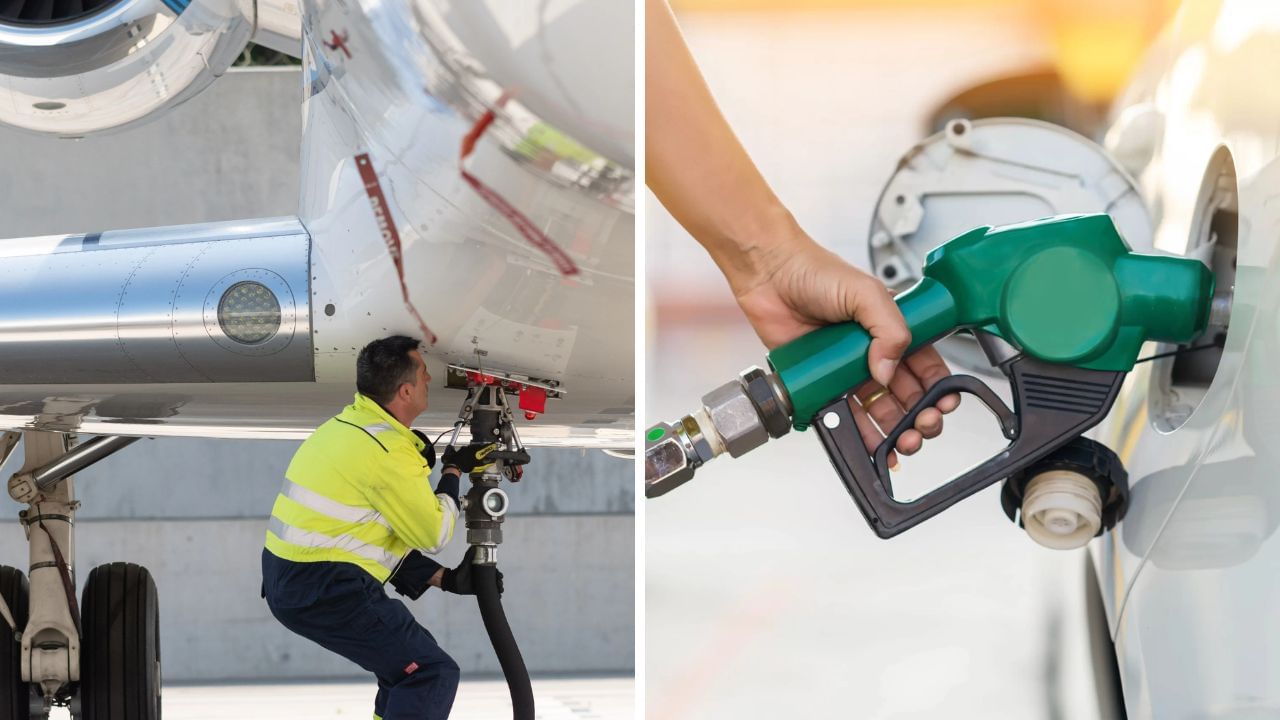
Rising petrol prices have become a common concern. The comparison between driving a car and flying a plane, while seemingly similar, overlooks the significant fuel consumption involved in aviation, leading to higher overall costs. However, a key difference lies in the fuel itself: aviation fuel is often priced lower than the petrol used in cars.
Aviation Turbine Fuel (ATF) powers aircraft and helicopters equipped with jet engines. Although it may resemble petrol or diesel in appearance, or even be colorless, its chemical structure and properties are distinct. ATF is primarily kerosene-based and specifically refined to meet the rigorous demands of jet engines. Additives are included to prevent freezing at high altitudes and low temperatures, ensuring stable combustion within the engine.
Jet fuel currently offers a cost advantage over petrol. For instance, Indian Oil’s jet fuel price stands at approximately Rs 92 per liter in Delhi, around Rs 95.16 per liter in Kolkata, and Rs 86 per liter in Mumbai. In contrast, petrol prices in the same cities are around Rs 94.77 per liter in Delhi, Rs 103.50 per liter in Mumbai, and Rs 105.41 per liter in Kolkata.
The price difference stems from the tax structures applied. While both ATF and petrol are subject to central and state taxes, the varying VAT rates across states contribute to price discrepancies. The central government imposes excise duty on ATF, while state governments levy VAT. Despite varying rates across different states, the lower tax burden on ATF, compared to petrol, keeps it cost-effective for airlines. This lower taxation is intended to help reduce the operational expenses of the airlines.